

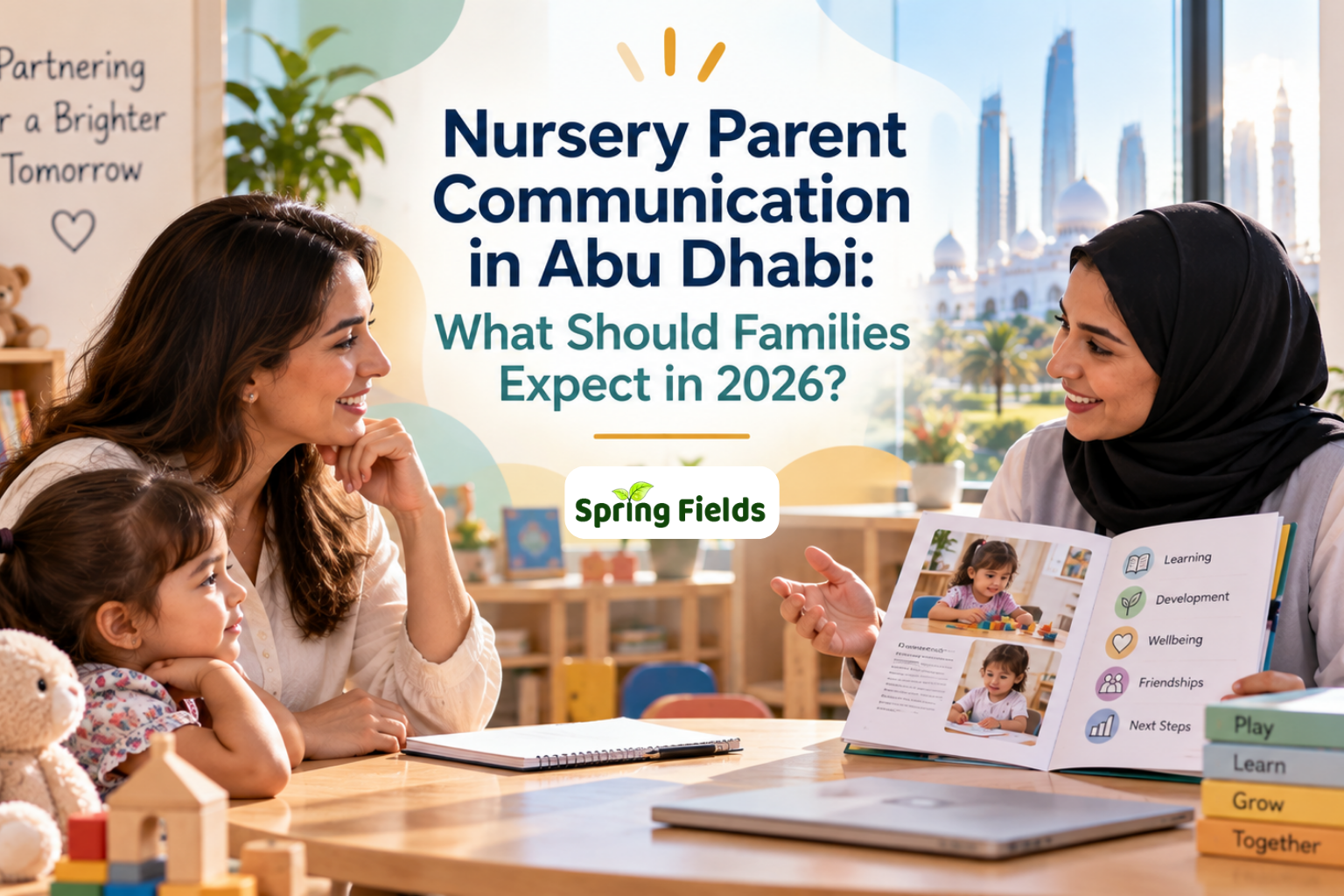
Nursery Parent Communication in Abu Dhabi: What Should Families Expect in 2026?
Choosing a nursery in Abu Dhabi is no longer only about classrooms, curriculum and activities.
Parents also want to know:
How well will the nursery communicate with me?
What did my child do today?
How are they settling in?
What are they learning?
Are they eating well?
How are they interacting with other children?
And if something changes, how quickly will I know?
For families with young children, communication between home and nursery can become an important part of the child’s overall experience.
Abu Dhabi’s early education framework recognises this relationship through its Parent Engagement and Communication Policy, which establishes expectations for communication and engagement between Early Education Institutions and families.
Why Parent-Nursery Communication Matters
A child spends important parts of their day in two environments:
Home and nursery.
When those environments communicate effectively, parents and educators can share useful information about the child’s routines, interests, behaviour and development.
For example, a parent might tell an educator:
“She has been unusually tired this morning.”
That small piece of information can help an educator understand the child’s behaviour during the day.
The same works in reverse.
A teacher might tell a parent:
“He spent a long time building with blocks today and was particularly interested in balancing them.”
That gives the parent insight into something that may not be obvious from simply asking, “How was nursery?”
What Good Nursery Communication Can Include
Communication does not have to mean sending parents a long report every evening.
Different types of communication can serve different purposes.
Daily Updates
Simple information about the child’s day can reassure parents about routines such as meals, rest, activities and general participation.
Developmental Updates
Parents should also receive meaningful information about their child’s development rather than only a list of completed activities.
This could include observations around:
- Language
- Communication
- Physical development
- Social interaction
- Independence
- Problem-solving
- Creativity
Direct Conversations
Digital updates are useful, but they should not replace conversations with educators.
Parents should have opportunities to discuss their child’s progress, concerns and interests directly with the people who work with them.
Important Notifications
If something significant happens during the day, parents need a clear way to receive the information promptly.
The objective is simple:
Parents should feel connected without being overwhelmed.
Why This Matters Even More for Toddlers
Toddlers cannot always explain what happened during their day.
A two-year-old may not be able to tell their parents:
“I found it difficult to separate from you this morning, but I eventually became comfortable and joined an activity.”
An educator can provide that context.
This is especially useful during changes in routine, new classroom experiences or developmental transitions.
ADEK’s settling-in policy recognises that adjusting to an Early Education Institution can take one to three weeks depending on the child, reinforcing the importance of communication between the nursery and family during this period.
Communication Should Be a Two-Way Process
Parent communication shouldn’t mean a nursery simply sending information to families.
Parents should also be able to share information with educators.
A child’s home experiences can provide useful context.
For example:
- A new sibling has arrived.
- The child has changed their sleeping routine.
- The child has developed a new interest.
- The family has introduced a new language at home.
- The child is experiencing a change in routine.
These details can help educators understand behaviour and interests more effectively.
This is why parent partnership is different from simply receiving nursery notifications.
What Should Parents Ask During a Nursery Visit?
When visiting a nursery in Abu Dhabi, parents often ask about fees, curriculum, timings and facilities.
Add communication to the list.
Ask these questions:
1. How do you communicate with parents?
Is communication through an app, email, phone, face-to-face meetings or a combination?
2. How often do parents receive updates?
Understand what is included in routine communication.
3. How do you share developmental observations?
Parents should know how they can understand their child’s progress.
4. Who should I contact if I have a concern?
There should be a clear communication pathway.
5. How do educators communicate important changes?
Ask what happens if a child becomes unwell, upset or requires additional support.
6. Can parents speak directly with educators?
Technology can support communication, but personal interaction still matters.
Technology Can Help — But It Shouldn’t Replace People
Many nurseries now use digital systems to make parent communication easier.
Parents may receive:
- Photos
- Activity updates
- Announcements
- Reminders
- Meal information
- Attendance information
- Progress observations
These tools can be convenient.
But early childhood education remains fundamentally human.
A notification cannot replace an educator who understands a child’s personality.
A photograph cannot always explain why a child behaved differently that day.
And an app cannot replace a meaningful conversation between a parent and teacher.
The best approach is to use technology to support communication, not to replace relationships.
What This Means for Working Parents in Abu Dhabi
For working parents, communication becomes particularly valuable.
Parents may not be able to spend a lot of time at nursery during the day.
A well-structured communication system can help them remain informed while continuing their work responsibilities.
This is especially relevant in central Abu Dhabi, where families living and working around areas such as Al Danah, Al Falah and Najda Street may prioritise accessibility as well as a nursery’s learning environment.
For parents, the ideal experience is not necessarily receiving more messages.
It is receiving the right information at the right time.
Abu Dhabi’s Early Years Sector Is Putting More Attention on Family Partnership
The direction of Abu Dhabi’s early education sector increasingly places children’s development within a wider family context.
ADEK’s recent expansion of Al Ghad Nurseries, for example, explicitly links early education with children’s cognitive, social and emotional development while also highlighting family wellbeing.
At the same time, ADEK’s early education policies cover areas including parent engagement, physical activity, the learning environment and settling-in.
For parents, this means choosing a nursery can involve looking beyond the classroom itself.
How does the nursery work with your family?
That can be just as important as what happens inside the classroom.
Choosing a Nursery in Abu Dhabi: Look Beyond the Brochure
A nursery brochure can tell you about:
- Curriculum
- Facilities
- Activities
- Classrooms
- Timings
But a conversation with the nursery can tell you much more.
Ask how educators communicate.
Ask how they share progress.
Ask how they involve parents.
Ask what happens when a child needs additional support.
And ask how they make parents part of the child’s early learning journey.
For families considering a nursery in Abu Dhabi, these questions can make the selection process much more meaningful.
At Spring Fields Preschools, children learn through a play-based approach aligned with the British EYFS framework, with learning experiences designed around their developmental stage.
Explore the Spring Fields classes or learn more about the preschool.
FAQs
How important is parent communication when choosing a nursery in Abu Dhabi?
It is an important part of understanding how a nursery works with families. Parents can ask how updates, developmental observations, concerns and important notifications are handled.
What should a nursery tell parents about their child?
Depending on the nursery’s communication system, parents may receive information about routines, activities, participation, development and significant events during the child’s day.
How often should parents communicate with nursery educators?
There is no single frequency that suits every child or situation. Routine updates can be supplemented by direct conversations when parents or educators have something important to discuss.
Should nurseries use apps for parent communication?
Digital platforms can make communication convenient, but they should complement rather than replace meaningful communication between parents and educators.
What should parents ask during a nursery visit?
Ask about communication methods, developmental updates, educator accessibility, how concerns are handled and how parents are involved in their child’s learning.