

Toddler Development Abu Dhabi: A Parent’s Guide to the Early Years
Toddler development Abu Dhabi is a topic every parent should understand before choosing a nursery, planning activities at home or comparing their child’s progress with other children.
The toddler years are full of enormous change. A child who was dependent on adults for almost everything can quickly begin talking, running, exploring, expressing preferences, solving simple problems and developing relationships with other children.
But development doesn’t happen in one straight line.
One toddler may speak early but take longer to develop physical confidence. Another may be very social but still developing language. A third may be physically adventurous but need more time to become comfortable in group activities.
This is why understanding toddler development in Abu Dhabi should be about looking at the whole child rather than focusing on one milestone.
The Abu Dhabi Early Childhood Authority (ECA) describes early childhood development as covering the period from birth through age eight and works across health and nutrition, child protection, family support, and education and early care. Its early-childhood strategy identifies physical, cognitive, linguistic and social-emotional development as interconnected areas of development.
For parents, that provides a useful framework:
A toddler isn’t developing one skill at a time. They are developing many connected abilities simultaneously.
What Is Toddler Development?
Toddler development refers to the changes children experience across several areas as they move through the early years.
These include:
- Physical development
- Language development
- Cognitive development
- Social development
- Emotional development
- Communication
- Independence
- Fine motor skills
- Gross motor skills
- Problem-solving
- Self-regulation
The exact age at which a child develops a particular ability can vary.
That is normal.
A developmental milestone should therefore be viewed as a general guide, not a deadline.
The most useful question isn’t:
“Is my child doing exactly what another child is doing?”
Instead ask:
“Is my child learning, developing and progressing over time?”
Why Toddler Development Matters So Much
The first few years are particularly important because children’s brains and foundational abilities are developing rapidly.
ADEK describes the early years as a critical period for brain development, including the foundations for cognitive skills, academic achievement, social-emotional wellbeing and lifelong health. Abu Dhabi currently has more than 200 private nurseries serving children from birth to age four across multiple curricula.
That makes the nursery years much more than preparation for “big school.”
They are part of the child’s development itself.
A toddler is learning how to:
- Communicate needs
- Understand routines
- Handle emotions
- Interact with others
- Move confidently
- Explore safely
- Make choices
- Solve simple problems
- Develop independence
These abilities become foundations for later learning.
The 4 Major Areas of Toddler Development
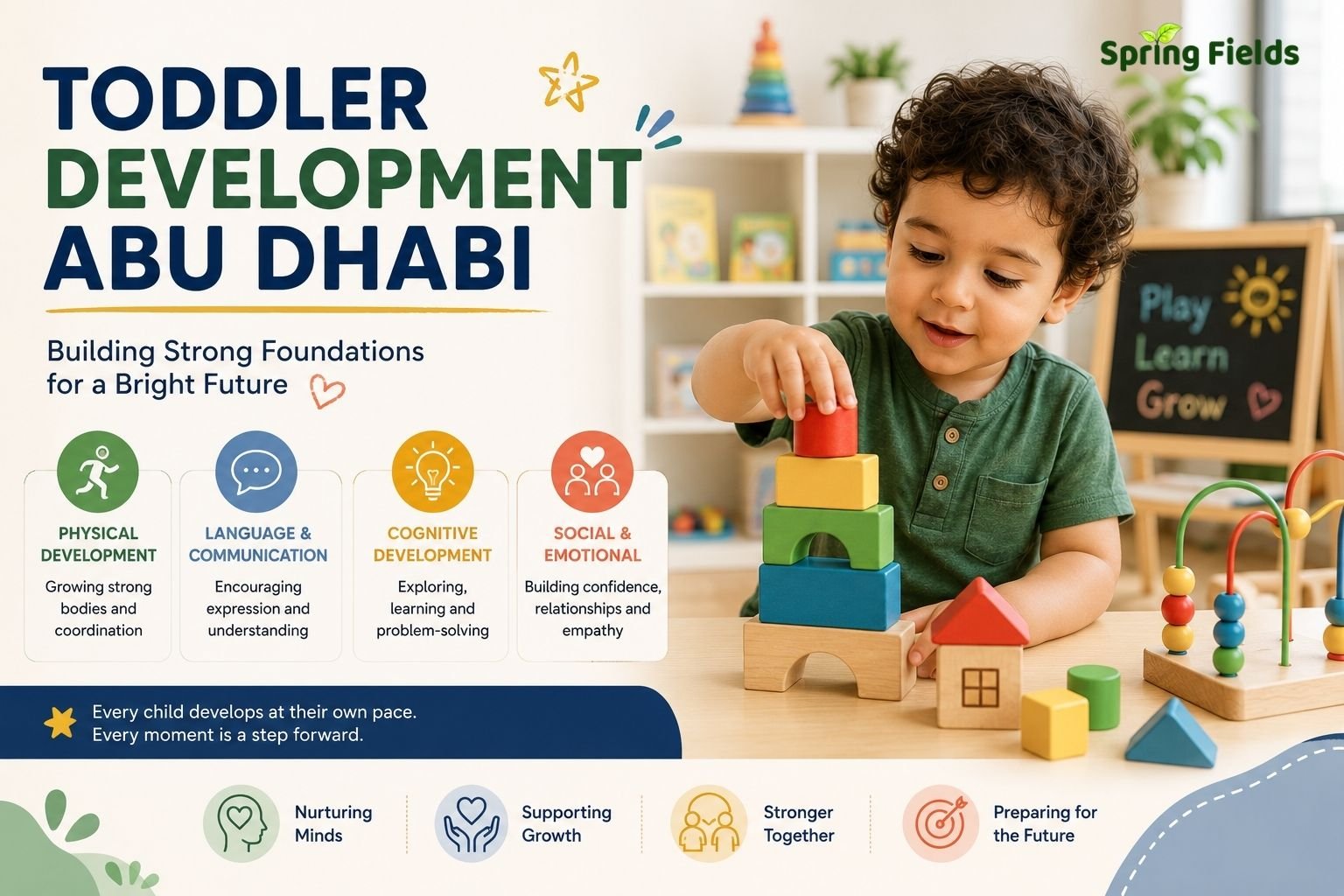
A useful way for Abu Dhabi parents to think about toddler development is through four interconnected areas.
1. Physical Development
This includes both gross motor and fine motor development.
Gross motor skills
These involve larger movements such as:
- Walking
- Running
- Jumping
- Climbing
- Balancing
- Kicking
- Throwing
- Catching
Fine motor skills
These involve smaller movements using the hands and fingers.
Examples include:
- Turning pages
- Holding crayons
- Building with blocks
- Using simple utensils
- Completing puzzles
- Threading objects
- Opening containers
- Drawing
A child doesn’t need to perform these skills perfectly.
What matters is that they have regular opportunities to practise.
2. Language and Communication Development
Language development is one of the most noticeable areas during the toddler years.
Children gradually move from gestures and single words toward more complex communication.
They begin to:
- Name familiar objects
- Ask for things
- Follow simple instructions
- Understand questions
- Combine words
- Tell simple stories
- Express preferences
- Talk about experiences
- Participate in conversations
But language isn’t just about how many words a child can say.
Understanding matters too.
A toddler may understand considerably more than they can express.
That is why parents should pay attention to both:
Receptive language
What the child understands.
Expressive language
What the child communicates through speech, sounds, gestures and words.
3. Cognitive Development
Cognitive development involves how children think, remember, explore and solve problems.
For toddlers, this can look very simple.
A child might:
- Work out how to open a box
- Remember where a toy was hidden
- Match shapes
- Sort objects
- Complete a simple puzzle
- Understand basic cause and effect
- Copy an adult’s actions
- Try different ways to solve a problem
A toddler knocking over a tower and rebuilding it isn’t “just playing.”
They are experimenting.
They are learning:
“If I put this here, what happens?”
That is early problem-solving.
4. Social-Emotional Development
This area is sometimes underestimated.
Toddlers are learning:
- How to interact with others
- How to express emotions
- How to respond when frustrated
- How to wait
- How to share
- How to follow simple social rules
- How to form relationships
- How to become increasingly independent
A toddler saying:
“Mine!”
isn’t necessarily being deliberately difficult.
They are still developing the ability to understand another person’s perspective and regulate strong emotions.
Adults can help by naming feelings and providing consistent boundaries.
For example:
“You are upset because you wanted the red car. We can wait until your friend is finished.”
The child is learning both emotional vocabulary and social expectations.
Toddler Development Is Not a Race
One of the biggest mistakes parents make is comparing their child with another toddler.
You might hear:
“My friend’s child was speaking in sentences at two.”
or:
“My neighbour’s child can already write their name.”
That information may create unnecessary anxiety.
Children develop at different rates.
Their development can be influenced by:
- Individual temperament
- Genetics
- Environment
- Language exposure
- Opportunities for play
- Relationships
- Health
- Sleep
- Nutrition
- Learning environment
A multilingual child may distribute vocabulary across two or more languages rather than using one language exclusively.
A cautious child may take longer to participate in a new group.
A highly active child may need more opportunities for physical exploration.
Context matters.
Toddler Development and Multilingual Families in Abu Dhabi
Abu Dhabi is a highly multicultural environment.
Many children grow up hearing:
- Arabic
- English
- Hindi
- Malayalam
- Urdu
- Bengali
- Tagalog
- Or several other languages
This can make language development look different from what parents expect.
A multilingual toddler may understand one language better than another.
They may use different languages with different people.
They may sometimes mix words from different languages.
This does not automatically mean the child is confused.
Instead of focusing only on the number of words in one language, parents should consider the child’s overall communication ability across the languages they hear.
This is especially relevant when choosing a nursery.
Ask:
“How does the nursery support children who speak more than one language at home?”
That question can tell you a lot about the learning environment.
How Play Supports Toddler Development
For toddlers, play is not separate from learning.
Play is one of the primary ways young children learn.
A simple block activity can support:
- Fine motor skills
- Spatial awareness
- Problem-solving
- Language
- Imagination
Pretend play can support:
- Communication
- Social skills
- Creativity
- Emotional expression
Outdoor play can support:
- Balance
- Coordination
- Strength
- Confidence
- Physical awareness
Art can support:
- Fine motor control
- Creativity
- Vocabulary
- Concentration
This is why parents shouldn’t worry that their toddler is “only playing.”
The better question is:
What is the child learning through the play?
10 Everyday Activities That Support Toddler Development
You don’t need expensive educational toys.
Some of the most useful activities can happen at home.
1. Building Blocks
Encourage your child to build towers, bridges and simple structures.
Ask:
“What are you building?”
This adds language to physical exploration.
2. Reading Together
Read picture books every day.
Ask:
“Where is the dog?”
“What is she doing?”
“What happens next?”
Reading supports language, attention and imagination.
3. Sorting Games
Sort objects by:
- Colour
- Size
- Shape
- Type
This introduces early mathematical thinking.
4. Simple Puzzles
Puzzles encourage:
- Problem-solving
- Concentration
- Visual recognition
- Fine motor skills
5. Pretend Play
Create a pretend:
- Shop
- Kitchen
- Doctor’s clinic
- Restaurant
- School
Pretend play is excellent for language and social development.
6. Music and Movement
Sing songs.
Clap.
Dance.
Copy movements.
This supports language, rhythm, coordination and memory.
7. Outdoor Exploration
Go outside and look for:
- Leaves
- Birds
- Flowers
- Cars
- Clouds
- Different sounds
Ask your child what they notice.
8. Helping at Home
Let toddlers:
- Put toys away
- Carry safe objects
- Help set the table
- Put clothes in a basket
- Choose between two outfits
These small tasks support independence.
9. Water Play
Supervised water play can encourage:
- Pouring
- Scooping
- Comparing
- Measuring
- Vocabulary
- Fine motor control
10. Drawing
Give your child crayons and paper.
Don’t worry about what the picture looks like.
The process is what matters.
Why Independence Matters During Toddler Development
Parents naturally want to help.
But sometimes helping too quickly can reduce opportunities for children to practise independence.
If your toddler is struggling to put on their shoes, you don’t always have to do it immediately.
Try:
“You try first. I’ll help if you need me.”
This teaches:
- Persistence
- Problem-solving
- Confidence
- Independence
The child learns:
“I can try.”
That mindset becomes increasingly important as they grow.
Emotional Development: Helping Toddlers Handle Big Feelings
Toddlers experience strong emotions without having fully developed emotional regulation.
They can become:
- Angry
- Excited
- Frustrated
- Jealous
- Scared
- Overwhelmed
Parents don’t need to eliminate every difficult emotion.
Instead, help children understand and manage emotions.
For example:
“You’re angry because we have to leave the park.”
Then provide a boundary:
“We are leaving now. You can hold my hand or walk beside me.”
The child learns:
My feelings are real, but feelings don’t control every action.
This is an important foundation for social-emotional development.
Why Routines Help Toddler Development
Toddlers often feel more secure when they know what happens next.
A predictable routine can include:
Wake up → breakfast → nursery → play → lunch → rest → outdoor time → dinner → bedtime
The exact schedule doesn’t matter as much as consistency.
Routines can support:
- Independence
- Memory
- Communication
- Emotional security
- Understanding expectations
This is also one reason nursery routines matter.
A well-structured early-years environment gives children repeated opportunities to practise skills in familiar contexts.
What Should Parents Look for in a Nursery?
If you’re researching toddler development Abu Dhabi, don’t choose a nursery only because it has attractive classrooms or impressive equipment.
Ask how the nursery supports development.
Ask about physical development
“How much time do children spend moving and playing outdoors?”
Ask about language
“How do educators encourage children to communicate?”
Ask about social skills
“How do you support children when they have disagreements?”
Ask about independence
“What responsibilities are toddlers encouraged to manage themselves?”
Ask about play
“How much of the day is child-led play?”
Ask about individual differences
“How do you adapt activities for children developing at different rates?”
These questions reveal more than a brochure.
What Does Abu Dhabi Expect From Early Childhood Development?
Abu Dhabi has made early childhood development a major policy priority.
The Abu Dhabi Early Childhood Authority’s strategy is built around creating conditions where children can flourish in a safe, family-friendly environment. Its work spans health and nutrition, child protection, family support, and education and early care.
The ECA also identifies outcomes such as children being sociable, expressing feelings appropriately, developing emerging logical thinking and problem-solving skills, and using technology appropriately and responsibly.
This reinforces an important idea:
Early childhood development isn’t only academic preparation.
It includes the child’s:
body + mind + language + emotions + relationships + environment.
Early Intervention: When Parents Have Concerns
Parents sometimes notice that their child seems to be developing differently from other children.
That does not automatically mean something is wrong.
However, concerns shouldn’t simply be ignored.
If you’re worried about your child’s development, start by discussing what you’ve noticed with:
- Your child’s nursery educator
- Your paediatrician
- A qualified child-development professional
Abu Dhabi’s Early Childhood Authority provides an Early Intervention Guide covering intervention services available to families of children experiencing developmental delays or disabilities in Abu Dhabi.
The key principle is:
Getting advice early is better than waiting because you are afraid of overreacting.
Professional assessment can provide clarity.
Signs Parents Should Pay Attention To
Parents shouldn’t diagnose their child based on an online article.
However, it is reasonable to pay attention if you notice:
- Little or no progress over time
- Significant difficulty communicating
- Loss of previously acquired skills
- Major difficulty interacting with others
- Persistent difficulty following age-appropriate instructions
- Significant challenges with movement
- Strong concerns about hearing or vision
- Difficulty using hands for everyday age-appropriate activities
Most importantly:
Regression deserves attention.
If a child loses a skill they previously had, parents should discuss it with a healthcare professional.
Toddler Development and Technology
Technology is now part of family life, including in Abu Dhabi.
The question isn’t simply:
“Is technology good or bad?”
The more useful question is:
“What is the technology replacing?”
If a toddler spends time on a device instead of:
- Talking
- Playing
- Sleeping
- Moving
- Reading
- Exploring
- Interacting with family
then parents should reconsider the balance.
The Abu Dhabi Early Childhood Authority has specifically discussed the need to balance technological exposure with real-world experiences during children’s formative years.
Technology can have educational uses.
But toddlers still need human interaction and hands-on experiences.
AI and Toddler Development
Artificial intelligence is also entering children’s lives through apps, toys and educational platforms.
But toddlers don’t need sophisticated AI tools to develop.
Their most valuable learning experiences remain:
- Conversation
- Play
- Stories
- Music
- Movement
- Exploration
- Relationships
AI may be useful to parents and educators for creating activity ideas or resources.
But it shouldn’t replace the adult-child relationship.
This is particularly important because the toddler years are when children are developing communication, emotional understanding and social interaction.
Toddler Development and Outdoor Play in Abu Dhabi
Abu Dhabi’s climate means outdoor play needs thoughtful planning.
During cooler months, families can make greater use of:
- Parks
- Beaches
- Outdoor playgrounds
- Nature areas
- Walking spaces
During hotter months, parents may need to move outdoor activities to cooler parts of the day or choose appropriate indoor alternatives.
The goal is not to maximise outdoor time at any cost.
It’s to give children regular opportunities to move and explore safely.
Nutrition, Sleep and Toddler Development
Development doesn’t happen only during activities.
Children also need the foundations that support healthy growth.
That includes:
Sleep
Toddlers need adequate, consistent sleep.
Nutrition
Children need a balanced diet appropriate for their age.
Movement
Physical activity supports physical development and overall wellbeing.
Relationships
Responsive relationships help children develop socially and emotionally.
Security
Children benefit from predictable, safe environments.
This whole-child approach is consistent with Abu Dhabi’s early-childhood strategy, which treats health, family support, education and early care as interconnected parts of children’s development.
Toddler Development and Nursery: What Should the Day Look Like?
A good toddler day shouldn’t consist entirely of structured lessons.
Young children benefit from a balance of:
- Free play
- Guided activities
- Storytelling
- Music
- Outdoor play
- Creative activities
- Meals
- Rest
- Social interaction
- Quiet time
The exact timetable will differ between nurseries.
What matters is whether the day gives children opportunities to develop across multiple areas.
For parents comparing nurseries in Abu Dhabi, ADEK currently provides a nursery-finder service because the emirate has more than 200 private nurseries serving children aged 0–4.
That makes it particularly important to compare learning environments, not just locations and fees.
How Spring Fields Supports Early Development
Spring Fields Preschools in Abu Dhabi follows a British Early Years Foundation Stage (EYFS) approach, with an emphasis on play, exploration, communication, creativity and children’s overall development.
Its programmes include age-specific classes for young children, allowing activities and expectations to be adapted according to children’s developmental stages.
Parents considering SFN can explore the Spring Fields nursery classes to understand the different age groups and programme structure.
The nursery’s approach also connects naturally with the principles discussed in this article: young children need opportunities to play, communicate, explore, move and develop independence.
Parents can also read the SFN guide to the importance of play in early childhood for a deeper look at how play contributes to development.
For families preparing to select a nursery, the Abu Dhabi nursery parent checklist provides another useful resource.
A Simple Toddler Development Checklist for Parents
Instead of tracking dozens of milestones, think about these six questions.
Communication
Does my child have opportunities to talk, listen and express themselves?
Movement
Does my child get opportunities to run, climb, balance and use their hands?
Thinking
Does my child get opportunities to experiment and solve simple problems?
Social development
Does my child interact with adults and other children?
Emotional development
Am I helping my child name and manage feelings?
Independence
Does my child get safe opportunities to do things for themselves?
If the answer to all six is generally yes, you’re already creating a strong developmental environment.
15 Simple Ways Parents Can Support Toddler Development
- Talk to your child throughout the day.
- Read together every day.
- Give your child time to play independently.
- Provide opportunities for physical movement.
- Let your child make simple choices.
- Encourage pretend play.
- Name emotions.
- Give your child time to try before helping.
- Sing songs and nursery rhymes.
- Explore outdoors together.
- Limit passive screen use.
- Create predictable routines.
- Encourage interaction with other children.
- Celebrate effort rather than perfection.
- Ask questions and listen to the answers.
None of these require expensive equipment.
They require something much more valuable:
Time and attention.
The Goal Isn’t a “Perfect” Toddler
Parents can become overwhelmed by milestone charts.
They may feel that their child needs to:
- Speak a certain number of words
- Know colours
- Count
- Recognise letters
- Draw
- Share
- Sit quietly
- Follow instructions
all at exactly the “right” age.
But development isn’t a competition.
The goal is not to produce a perfect toddler.
The goal is to provide an environment where the child can:
explore safely, communicate freely, build relationships, develop confidence and gradually become more independent.
Final Thoughts on Toddler Development in Abu Dhabi
Understanding toddler development Abu Dhabi parents can support at home and through nursery begins with looking at the whole child.
Physical development matters.
Language matters.
Cognitive development matters.
Social and emotional development matter.
And none of these areas exist in isolation.
A child running outside is also learning.
A child talking to a parent is also learning.
A child sharing blocks with another child is learning.
A child struggling with a puzzle is learning.
A child pretending to cook is learning.
A child asking “why?” for the tenth time is learning.
Abu Dhabi’s early-childhood strategy reflects this broader view of development, with government efforts focused on helping children flourish through education and early care, family support, health and nutrition, and child protection.
For parents, the practical message is simple:
Talk to your child.
Read with them.
Let them play.
Let them move.
Give them opportunities to try.
Help them understand their emotions.
Give them time with other children.
Create predictable routines.
And if something about your child’s development concerns you, don’t rely on comparisons with other children or random internet checklists. Speak with the appropriate professional and seek guidance early.
The toddler years don’t need to be perfect.
They need to be safe, responsive, active, playful and full of opportunities to learn.
Frequently Asked Questions
What are the main areas of toddler development?
The major areas include physical, cognitive, language and social-emotional development. Abu Dhabi’s Early Childhood Development Strategy identifies these as interconnected areas that contribute to children’s overall development.
What age is considered the toddler stage?
The term toddler generally refers to children in the period between infancy and the preschool years, although definitions vary. Development is individual, so parents should focus on progression rather than treating a particular birthday as a strict developmental deadline.
What should a two-year-old be learning?
A two-year-old can learn through everyday conversations, books, songs, physical movement, pretend play, simple puzzles, sorting activities and social interaction. Formal academic instruction is not necessary for most toddler learning.
How can I support toddler development at home?
Talk, read, sing, play, explore outdoors, provide opportunities for movement and allow your child to practise age-appropriate independence. Everyday routines can become valuable learning opportunities.
Is play important for toddler development?
Yes. Play can support language, physical development, problem-solving, creativity, social skills and emotional development. Different types of play provide opportunities to practise different abilities.
Should toddlers learn academically before starting school?
Toddlers benefit more from developmentally appropriate experiences than from pressure to complete formal academic work. Language, communication, physical development, curiosity, independence and social-emotional skills provide important foundations for later learning.
Does bilingualism affect toddler language development?
Children can develop multiple languages. A multilingual child’s vocabulary may be distributed across languages, so parents should consider the child’s overall communication rather than judging development from only one language.
When should parents be concerned about toddler development?
Parents should discuss concerns with a qualified professional if they notice significant developmental difficulties, a lack of progress or particularly if a child loses skills they previously had. Abu Dhabi’s Early Childhood Authority provides an Early Intervention Guide for families seeking information about developmental intervention services.
How important is nursery for toddler development?
A quality nursery can provide opportunities for children to develop communication, independence, physical skills, social relationships and problem-solving through age-appropriate activities and play. The quality and suitability of the environment matter more than simply attending nursery.
How do I choose a nursery for my toddler in Abu Dhabi?
Look at the learning environment, educator-child interaction, safety, routines, play opportunities, outdoor activities, communication with parents and how the nursery supports children developing at different rates. ADEK currently lists more than 200 private nurseries in Abu Dhabi for children aged 0–4.