

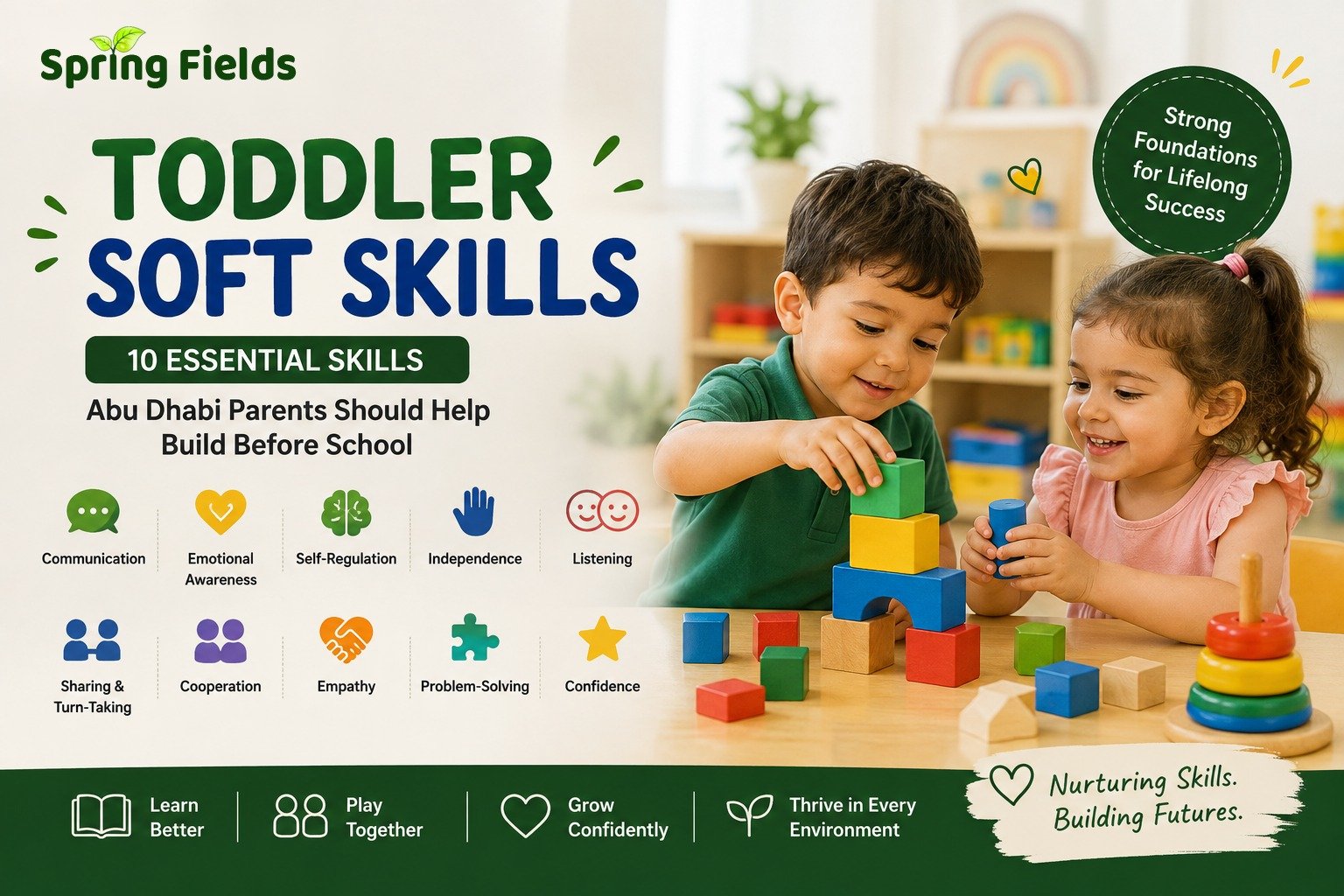
Toddler Soft Skills: 10 Essential Skills Abu Dhabi Parents Should Help Build Before School
When parents think about preparing a toddler for nursery or school, the first things that often come to mind are colours, numbers, letters and vocabulary.
Those skills matter.
But they are only part of the picture.
A toddler who knows the alphabet but struggles to communicate their needs, wait for a turn, separate from a parent or recover after frustration may still find the transition to nursery difficult.
That is why toddler soft skills deserve much more attention during the early years.
Soft skills are the everyday abilities that help children interact with people, manage emotions, communicate, solve small problems and become increasingly independent.
For toddlers, these skills are not taught through lectures or worksheets.
They develop through relationships, routines, play, conversation and repeated everyday experiences.
The National Association for the Education of Young Children (NAEYC) identifies social-emotional development as an important part of children’s overall learning and development, while its developmentally appropriate practice guidance highlights play as a central way children develop self-regulation, language, social competence and problem-solving skills.
For parents in Abu Dhabi, this is particularly relevant when preparing a child for nursery.
So, what are the most important soft skills for toddlers, and how can parents help develop them?
What Are Toddler Soft Skills?
Toddler soft skills are the social, emotional, communication and behavioural abilities children gradually develop as they interact with other people and their environment.
They include:
- Communication
- Sharing and turn-taking
- Emotional awareness
- Self-regulation
- Independence
- Listening
- Cooperation
- Empathy
- Problem-solving
- Confidence
These aren’t skills that children master overnight.
A two-year-old should not be expected to behave like a five-year-old.
Development happens gradually, and every child progresses at their own pace.
The goal is not to make toddlers perfectly behaved.
The goal is to give them repeated opportunities to practise.
1. Communication
Communication is one of the most important toddler soft skills.
It goes beyond knowing lots of words.
A child needs to gradually learn how to:
- Ask for something
- Express discomfort
- Say yes or no
- Identify feelings
- Listen to another person
- Respond to questions
- Make choices
- Get someone’s attention
For example, instead of immediately giving your toddler the toy they point at, you can encourage communication:
“Do you want the red car or the blue car?”
Even if they simply point, you are creating an opportunity to practise choice-making and communication.
Harvard’s Center on the Developing Child describes these responsive back-and-forth interactions between children and caring adults as “serve and return.” These exchanges help build foundations for language and social development.
Try this at home
Talk to your child during ordinary activities.
While getting dressed:
“Which shirt do you want?”
While preparing food:
“Should we cut the banana or the apple first?”
While playing:
“What is your teddy doing?”
These small conversations create meaningful language opportunities.
2. Emotional Awareness
Toddlers experience strong emotions.
They can be excited one minute and extremely frustrated the next.
That is normal.
What they are still learning is what those emotions mean and what to do with them.
Parents can help by naming feelings.
Instead of simply saying:
“Stop crying.”
Try:
“You’re upset because the toy is gone.”
Or:
“You wanted to do it yourself.”
This doesn’t mean giving the child everything they want.
It means helping them understand their internal experience.
NAEYC highlights recognising, labelling and managing emotions as important aspects of children’s social and emotional development.
Over time, children can begin moving from:
crying → identifying the feeling → communicating the need → finding a solution.
That progression takes time.
3. Self-Regulation
Self-regulation is one of the most valuable soft skills a child can gradually develop.
It means learning to manage emotions, attention and behaviour.
For toddlers, self-regulation is still developing.
A toddler who wants a toy immediately may not yet have the ability to calmly wait.
A child who becomes overwhelmed may need an adult to help them calm down.
That’s why parents should not expect adult-level emotional control from toddlers.
Instead, they can co-regulate with them.
For example:
“You’re angry. I’m here. Let’s take a breath together.”
The adult provides the calm that the child has not yet learned to create independently.
Recent NAEYC guidance continues to emphasise self-regulation as an important foundation for children’s participation in learning, relationships and later school experiences.
Simple ways to practise
- Waiting briefly before getting something
- Taking turns
- Following simple routines
- Pausing before grabbing
- Using words instead of hitting
- Taking calming breaths
- Helping clean up after an activity
These are tiny moments of self-regulation practice.
4. Sharing and Turn-Taking
“Share!”
Parents often say this when two toddlers want the same toy.
But genuine sharing is a surprisingly complex skill.
A toddler has to understand:
“I have something. Someone else wants it. I can allow them to use it too.”
That requires social awareness and impulse control.
Start with turn-taking rather than expecting perfect sharing.
For example:
“It’s your turn with the truck. Then it will be Sara’s turn.”
Use short, predictable turns.
Games can make this easier.
Try:
- Rolling a ball back and forth
- Taking turns adding blocks
- Taking turns pressing buttons
- Taking turns choosing a song
- Simple board games for older toddlers
Children gradually learn that waiting does not mean they have lost something forever.
5. Independence
Parents naturally want to help their children.
But doing everything for a toddler can unintentionally reduce opportunities to practise independence.
Toddlers can often participate in simple tasks such as:
- Putting toys away
- Choosing between two clothes
- Carrying their cup
- Putting shoes near the door
- Washing hands
- Helping set the table
- Carrying a small bag
- Trying to put on a jacket
The task doesn’t have to be completed perfectly.
The process matters.
NAEYC notes that high-quality toddler programmes support children through active, hands-on experiences and connect new learning with what children already know and can do.
Try saying:
“You try first. I’ll help if you need me.”
That simple sentence communicates confidence.
6. Listening and Following Instructions
A toddler doesn’t need to follow complicated instructions.
Start with simple, realistic requests.
For example:
“Please bring your shoes.”
Then gradually introduce two-step instructions:
“Pick up the book and put it on the table.”
This supports listening, memory and attention.
Make instructions:
- Short
- Clear
- Age appropriate
- Consistent
And whenever possible, make them part of everyday routines.
For example, before going outside:
“First shoes, then playground.”
The repetition helps the child understand sequences.
7. Cooperation
Cooperation means learning to participate with other people.
It could be as simple as helping put toys away.
Or working with another child to build a tower.
Or helping a parent carry something.
Instead of presenting cooperation as an obligation, make it part of the activity.
For example:
“Let’s clean up together.”
Then give your child a small job.
NAEYC’s guidance on social-emotional development emphasises the importance of positive relationships with caregivers and peers and opportunities for children to play, negotiate and compromise with others.
Cooperation becomes easier when children experience it repeatedly.
8. Empathy
Empathy develops gradually.
A toddler won’t always understand another person’s feelings.
But parents can help them notice emotions.
If another child is crying, you might say:
“Look, Ali is crying. I think he is sad.”
If your toddler accidentally knocks someone over:
“He fell down. Let’s see if he’s okay.”
You’re not demanding a sophisticated emotional response.
You’re helping your child notice other people.
Books are also useful.
Ask:
“How do you think the character feels?”
This encourages children to connect facial expressions, situations and emotions.
9. Problem-Solving
Toddlers encounter small problems all day.
A block doesn’t fit.
A toy is stuck.
A puzzle piece won’t go in.
A tower falls.
A shoe won’t come off.
The easiest response is often to solve the problem immediately.
But sometimes it is better to pause.
Ask:
“What could we try?”
Or:
“Can you think of another way?”
Give your child time.
They may surprise you.
NAEYC identifies play as an important context for developing problem-solving skills, while its guidance for toddlers emphasises active, hands-on exploration.
Problem-solving doesn’t need to look academic.
A child figuring out how to move a large block is already practising it.
10. Confidence and Willingness to Try
Confidence does not mean a toddler should never be afraid.
It means gradually developing the belief:
“I can try.”
That belief grows when children are allowed to attempt things.
Instead of saying:
“Let me do it.”
try:
“Would you like to try first?”
If they fail:
“That didn’t work. Let’s try another way.”
Praise the process rather than only the result.
Instead of:
“You’re so clever!”
try:
“You kept trying.”
or:
“You found another way.”
This teaches children that effort and persistence matter.
Why Soft Skills Matter Before Nursery
Parents sometimes think nursery readiness means knowing letters, numbers and colours.
Those skills can certainly be useful.
But a nursery child also needs to function within a group.
They may need to:
- Say goodbye to a parent
- Communicate with an educator
- Follow simple routines
- Wait briefly
- Participate in activities
- Interact with other children
- Ask for help
- Manage small frustrations
- Try something independently
These are all soft skills.
ADEK’s early education framework includes policies covering areas such as learning and development, settling-in, physical activity, staffing and the learning environment.
That broader view of early education matters.
Preparing a child for nursery is not simply about academic knowledge.
It is about helping them become increasingly comfortable being part of a learning community.
Play Is One of the Best Ways to Build Soft Skills
You don’t need a special “soft skills lesson” at home.
Play naturally creates opportunities.
Building blocks
Develop problem-solving, cooperation and persistence.
Pretend play
Develops language, imagination and social understanding.
Ball games
Practise turn-taking and coordination.
Dolls and stuffed animals
Create opportunities to talk about emotions and caring.
Drawing
Supports communication and fine-motor development.
Outdoor play
Provides opportunities for movement, exploration and social interaction.
NAEYC describes play as a central teaching practice supporting self-regulation, language, social competence, problem-solving and physical development.
Harvard’s Center on the Developing Child similarly highlights play and responsive interactions as important experiences supporting developing social and cognitive skills.
The Adult’s Role Matters More Than the Activity
A box of expensive educational toys cannot replace responsive interaction.
A simple game of peek-a-boo with an engaged adult can create meaningful developmental opportunities.
Harvard’s serve-and-return framework explains how responsive back-and-forth interactions help build neural connections and support early language and social development.
So while choosing toys and activities is useful, parents should also focus on how they interact with their child.
Follow their interests.
Respond to their attempts to communicate.
Ask questions.
Listen.
Give them time.
Celebrate effort.
Help them when they become overwhelmed.
These interactions build the foundation beneath many of the soft skills parents want their children to develop.
What Can Abu Dhabi Parents Practise Every Day?
You don’t need to add another complicated activity to your schedule.
Use everyday routines.
During breakfast
Let your child choose between two options.
Skill: decision-making.
During dressing
Let them try putting on one item independently.
Skill: independence.
During play
Take turns with a toy.
Skill: cooperation.
During a tantrum
Name the emotion and stay calm.
Skill: emotional regulation.
During shopping
Ask your child to help find something.
Skill: listening and following instructions.
At the playground
Encourage them to approach another child.
Skill: social confidence.
Before bedtime
Talk about something that happened during the day.
Skill: communication and reflection.
Small moments add up.
What Should Parents Look for in a Nursery?
If soft skills are important to your family, don’t only ask about academic preparation during a nursery tour.
Ask:
“How do you support social and emotional development?”
Also ask:
- How do educators handle conflicts between children?
- How do children practise turn-taking?
- How are emotions discussed?
- How are children encouraged to become independent?
- How does the nursery support settling-in?
- How much free and guided play is included?
- How do teachers communicate developmental progress to parents?
Observe the classroom too.
Do children have opportunities to interact?
Are educators responsive?
Can children access materials independently?
Are children encouraged to try things themselves?
A high-quality toddler environment should provide opportunities for relationships, hands-on play and exploration. NAEYC specifically highlights caring adult relationships, active play and exploration as important components of high-quality toddler programmes.
Soft Skills Don’t Develop on a Perfect Schedule
This is important.
Two toddlers of the same age can behave very differently.
One may happily approach other children.
Another may watch from a distance.
One may speak constantly.
Another may communicate primarily through gestures.
One may recover quickly from frustration.
Another may need considerable adult support.
That doesn’t automatically mean one child is “ahead”.
Children develop at different rates.
Parents should focus on progress rather than comparison.
If you have persistent concerns about your child’s communication, behaviour, hearing, movement or development, discuss them with your child’s paediatrician or an appropriately qualified professional.
A nursery can provide observations and support, but it should not replace professional developmental assessment where needed.
How Spring Fields Supports Early Development
At Spring Fields Preschools in Abu Dhabi, the early-years approach is built around the British EYFS framework and includes communication, social development, creativity, physical development and independence alongside early learning.
That makes soft skills part of the broader learning experience rather than something children are expected to learn separately.
Through purposeful play and everyday interactions, children can practise:
- Communicating with educators
- Playing with peers
- Making choices
- Exploring independently
- Participating in routines
- Solving simple problems
- Expressing feelings
- Developing confidence
Parents can explore Spring Fields’ nursery classes to see the age groups and programme structure.
The nursery’s daily routine in Abu Dhabi also provides parents with a useful example of how early learning can combine routines, activities and play.
For parents preparing an older preschooler for the next stage, SFN also has a guide to kindergarten readiness skills in Abu Dhabi.
A Simple Toddler Soft Skills Checklist
By the time your child begins nursery, don’t worry about checking every box.
Instead, look for gradual progress.
Communication
Can your child communicate basic needs in words, gestures or both?
Emotional awareness
Are they beginning to recognise or express emotions?
Self-regulation
Can they gradually calm with adult support?
Independence
Do they attempt simple tasks themselves?
Listening
Can they respond to simple instructions?
Turn-taking
Are they beginning to understand that other people have turns too?
Cooperation
Can they participate in simple shared activities?
Empathy
Do they notice when another person is upset?
Problem-solving
Will they attempt another approach when something doesn’t work?
Confidence
Are they increasingly willing to explore unfamiliar activities with support?
These are not pass-or-fail tests.
They are areas for growth.
Final Thoughts
The early years are not a race to see which child can read first, count highest or memorise the most words.
Academic skills matter.
But underneath them are the skills that help children actually use what they know.
A child needs to communicate.
They need to listen.
They need to manage frustration.
They need to cooperate.
They need to make choices.
They need to solve small problems.
They need to build relationships.
And they need to develop the confidence to try.
These are toddler soft skills, and they develop through ordinary moments repeated every day.
Talk to your child.
Listen to them.
Let them try.
Give them choices.
Play together.
Let them make small mistakes.
Give them time to solve problems.
And choose an early-learning environment where educators understand that social and emotional development is not separate from learning.
It is part of learning.
As NAEYC’s developmentally appropriate practice guidance states, play supports self-regulation, language, cognitive and social competencies, while Harvard’s research on serve-and-return interactions highlights the importance of responsive relationships in early development.
For toddlers, the most valuable preparation for the future may not be another worksheet.
It may simply be having the opportunity to play, connect, communicate, try, fail, try again and gradually become more independent.
Frequently Asked Questions
What are soft skills for toddlers?
Toddler soft skills are social, emotional, communication and behavioural abilities that help young children interact with others and manage everyday experiences. They include communication, cooperation, emotional awareness, self-regulation, independence, empathy, problem-solving and confidence.
Why are soft skills important for toddlers?
Soft skills help children participate in relationships, routines and learning environments. They can support communication, social interaction, emotional regulation, independence and the ability to cope with everyday challenges.
What are the most important soft skills before nursery?
Communication, emotional awareness, self-regulation, listening, independence, turn-taking, cooperation, empathy, problem-solving and confidence are all useful foundations for nursery.
How can I teach soft skills to my toddler?
Use everyday routines and play. Give your child simple choices, encourage turn-taking, name emotions, let them attempt tasks independently, read stories, play pretend games and involve them in simple household activities.
Does play help develop soft skills?
Yes. Play gives children opportunities to communicate, negotiate, cooperate, solve problems, regulate emotions and practise emerging skills. NAEYC identifies play as a central teaching practice for young children’s development and learning.
Should I teach my toddler soft skills directly?
Some skills can be taught intentionally, but toddlers learn many social and emotional skills through repeated experiences with responsive adults and other children. Modelling, coaching and practising during everyday situations can be more effective than formal lessons.
How can I help my toddler become more independent?
Give your child safe, age-appropriate opportunities to try things themselves. Let them choose between two options, put toys away, help with simple routines and attempt tasks before you step in.
What if my toddler is shy around other children?
Children have different temperaments. Some need more time to feel comfortable in new environments. Give your child opportunities for gradual social interaction without forcing them to participate before they are ready.
Can nursery help develop toddler soft skills?
Yes. A high-quality nursery provides regular opportunities for children to interact with educators and peers, follow routines, make choices, play, communicate and practise independence.