
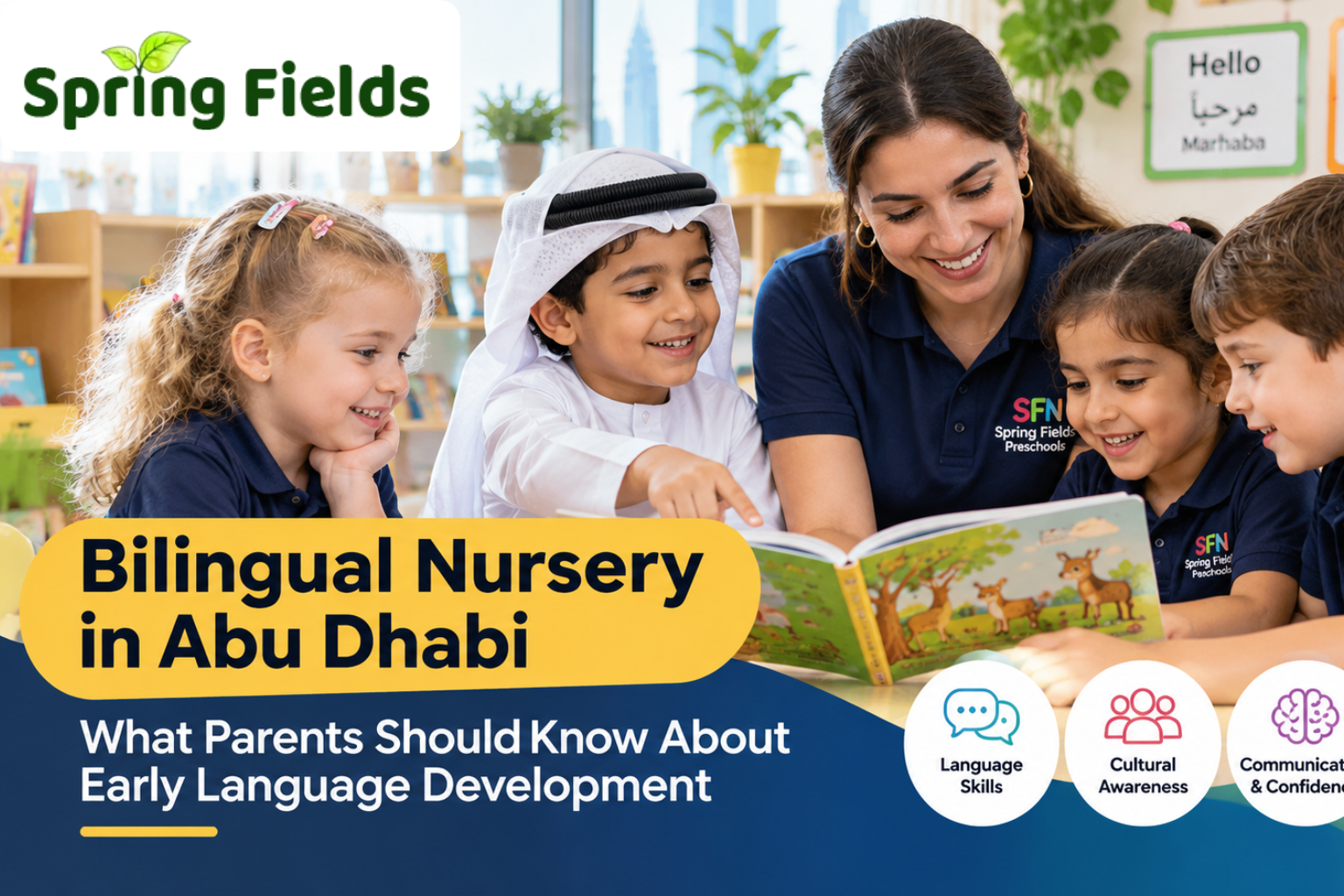
Bilingual Nursery in Abu Dhabi: What Parents Should Know About Early Language Development
Abu Dhabi is home to families from different countries, cultures and language backgrounds. Many children grow up hearing two or more languages at home, while learning English or Arabic through their everyday interactions.
For parents searching for a bilingual nursery in Abu Dhabi, choosing the right early learning environment involves more than finding a nursery that teaches multiple languages. It is important to understand how children develop communication skills, how different languages can be introduced and how educators support language development during the early years.
Early childhood is an important period for developing listening, speaking and communication abilities. With meaningful interaction, storytelling, play and consistent exposure, children can gradually become familiar with different languages.
Here is what parents should understand before choosing a nursery that supports multilingual development.
1. What Is a Bilingual Nursery?
A bilingual nursery provides an early learning environment where children are exposed to two languages through classroom communication, activities, storytelling, songs and everyday interactions.
The way languages are introduced can vary between nurseries.
Some use two languages throughout the school day, while others provide a primary teaching language alongside additional language activities.
Parents should understand the difference between:
- Bilingual education: Two languages are used as part of the educational programme.
- Language enrichment: Children are introduced to another language through songs, stories and structured activities.
- Multilingual exposure: Children interact with people who communicate in different languages in their everyday environment.
Before enrolling, ask the nursery which languages are used, how frequently children hear them and whether educators are trained to support language development.
2. Why Is Early Language Exposure Important?
Language is central to how children communicate, understand their surroundings and build relationships.
Exposure to different languages during early childhood can create opportunities to develop communication skills and cultural awareness.
Some important benefits include:
Better Communication Opportunities
Children who hear different languages in meaningful contexts have opportunities to recognise new words, sounds and expressions.
Conversations, songs, storytelling and everyday interactions help them gradually understand how language is used.
Cultural Awareness
Growing up in a multicultural environment allows children to become familiar with different traditions, expressions and ways of communicating.
This can encourage curiosity, respect and an appreciation of cultural differences.
Listening and Understanding
Hearing different words, sounds and sentence structures provides opportunities to practise listening and understanding.
Children gradually learn to recognise familiar expressions and respond according to the situation.
Confidence in Social Interaction
Language is an important part of making friends and participating in group activities.
A supportive nursery environment gives children opportunities to communicate with educators and other children while developing confidence.
It is important to remember that every child develops at a different pace. Multilingual exposure does not guarantee faster language development or higher academic performance.
3. How Do Children Learn Two Languages at an Early Age?
Young children learn languages through meaningful experiences rather than memorising vocabulary lists.
Their everyday environment plays an important role.
Some common ways children encounter different languages include:
Conversations: Talking with parents, educators and other children introduces familiar words and expressions.
Storytelling: Picture books and stories help children connect words with objects, actions and situations.
Music and rhymes: Songs introduce pronunciation, rhythm, repetition and new vocabulary.
Play-based activities: Role-play, pretend games and group activities create natural opportunities to communicate.
Everyday routines: Greeting others, discussing meals, identifying objects and following simple instructions introduce language in practical contexts.
The most effective experiences are interactive, consistent and appropriate for the child’s age.
4. Does Learning Two Languages Confuse Toddlers?
This is a common concern among parents.
Children who grow up hearing multiple languages may sometimes use words from different languages in the same sentence. This is known as code-switching or language mixing.
It is a normal feature of multilingual communication and does not automatically indicate confusion.
For example, a child might use an English word while speaking a sentence in another language because that particular word is more familiar.
Parents should focus on meaningful communication rather than expecting children to separate languages perfectly at every stage.
If parents have concerns about their child’s speech or language development, they should discuss them with a qualified healthcare professional or speech and language specialist.
5. English and Arabic Language Exposure in Abu Dhabi
Abu Dhabi provides a multicultural environment where children may encounter English, Arabic and several other languages in everyday life.
Both English and Arabic have important roles in the UAE’s educational and cultural environment.
Parents may therefore look for nurseries that provide opportunities for children to become familiar with different languages while developing their communication abilities.
When evaluating a nursery, consider asking:
- Which language is primarily used in the classroom?
- Are additional languages introduced through planned activities?
- Do educators communicate with children in languages they understand?
- Are stories, songs and learning resources available in different languages?
- How does the nursery support children who are still developing their English vocabulary?
The answers will help parents understand whether a nursery’s language environment matches their expectations.
6. What Should Parents Look for in a Bilingual Nursery in Abu Dhabi?
Choosing a nursery requires looking beyond the number of languages advertised.
Consider these factors before making a decision.
A Clear Language Approach
The nursery should explain how languages are incorporated into its daily programme.
Parents should understand whether children receive structured bilingual instruction or general exposure to additional languages.
Qualified Educators
Educators should understand early childhood communication and know how to encourage children to participate in conversations and activities.
Age-Appropriate Learning Activities
Young children learn through interaction and exploration.
Look for storytelling, music, creative activities, role-play and opportunities for group communication.
A Supportive Environment
Children should feel comfortable expressing themselves without pressure to speak perfectly.
Educators should encourage communication while respecting individual developmental differences.
Parent Communication
Ask how the nursery shares information about children’s communication, participation and development.
Regular communication helps parents understand what their children are experiencing at school.
7. How Can Parents Support Multilingual Development at Home?
Language development does not stop when children leave nursery.
Parents can create opportunities for communication through simple everyday activities.
Speak naturally in your preferred language. Parents should use the language they are most comfortable speaking rather than feeling pressured to communicate exclusively in English.
Read together regularly. Picture books and simple stories in different languages introduce vocabulary and encourage conversations.
Use songs and rhymes. Repetition helps children become familiar with sounds, expressions and everyday words.
Encourage conversations. Talk about toys, food, family activities and things children see around them.
Avoid unnecessary pressure. Give children time to understand and respond. Communication should feel enjoyable rather than like a test.
Maintain consistency. Regular interaction provides repeated opportunities to practise familiar words and expressions.
A positive language environment at home can complement the experiences children receive at nursery.
8. What Is the Role of EYFS in Language Development?
The British Early Years Foundation Stage (EYFS) framework identifies Communication and Language as one of its three prime areas of learning and development.
The framework also includes:
- Physical Development.
- Personal, Social and Emotional Development.
- Literacy.
- Mathematics.
- Understanding the World.
- Expressive Arts and Design.
Communication and Language focuses on listening, attention, understanding and speaking.
These abilities are developed through everyday experiences, conversations, storytelling and interactions with others.
At Spring Fields Preschools, the learning programme follows the British EYFS framework and uses purposeful play and age-appropriate experiences to support children’s overall development.
Parents can learn more about the EYFS learning approach at Spring Fields.
9. English-Speaking and Multicultural Learning Environments at Spring Fields Preschools
Spring Fields Preschools provides early childhood care and education for children from 2 months to 4 years in Abu Dhabi.
Its learning approach follows the British EYFS framework, combining structured learning with imaginative play, exploration and age-appropriate activities.
The nursery offers the following published class groups:
- Toddler Class: 1–2 years.
- Nursery Class: 2–3 years.
- F-S1 Class: 3–4 years.
Children are encouraged to develop communication, creativity, independence and confidence through meaningful learning experiences.
For families exploring an English-speaking nursery in Abu Dhabi, understanding the classroom language environment is an important part of choosing the right setting.
Parents can explore the Spring Fields nursery classes and age groups or learn more about its English-speaking nursery environment.
Families interested in Arabic language exposure can also read our guide to Arabic Nursery Education in Abu Dhabi.
For information about individual language activities and classroom arrangements, parents are encouraged to speak directly with the nursery team.
10. Choosing the Right Early Learning Environment for Your Child
Every child has a different language background, learning preference and developmental pace.
Some children may already hear English and Arabic at home, while others may be introduced to a new language for the first time when they begin nursery.
The right early learning environment should encourage communication without creating unnecessary pressure.
Parents should consider the nursery’s teaching approach, educator experience, classroom interactions and opportunities for meaningful learning.
A supportive environment can help children become comfortable communicating, exploring new experiences and building relationships.
Give Your Child a Positive Start at Spring Fields Preschools
Looking for an early learning environment in Abu Dhabi that encourages communication, curiosity and confidence?
Spring Fields Preschools offers age-appropriate early education through a learning approach guided by the British EYFS framework.
Parents are welcome to explore the nursery, understand the available programmes and discuss their child’s individual learning needs with the team.
Contact Spring Fields Preschools to learn more about its classes and current admission availability.
Website: https://springfieldspreschools.com/
Address: No. 48, Al Falah Sector, East 18/3, Najda Street, Behind Burjeel Hospital, Al Danah, Abu Dhabi.
Phone: 02 622 0130 | 056 853 1555
Email: administration@springfieldspreschools.com
Frequently Asked Questions
1. What is a bilingual nursery in Abu Dhabi?
A bilingual nursery introduces children to two languages through classroom communication, educational activities, storytelling and everyday interactions. The actual language arrangement varies between nurseries.
2. Is bilingual education suitable for toddlers?
Children can be exposed to multiple languages during their early years. The learning experience should be age-appropriate, interactive and supportive of individual developmental needs.
3. Can learning two languages confuse a child?
Using words from different languages is common among multilingual children. It does not automatically indicate confusion or a developmental problem.
4. Should parents speak English at home if it is not their first language?
No. Parents should communicate naturally in the language they are most comfortable using. Reading, storytelling and everyday conversations can support children’s overall language development.
5. How does EYFS support communication and language development?
EYFS includes Communication and Language as one of its three prime learning areas. It encourages listening, understanding, speaking and interaction through meaningful learning experiences.
6. What should parents ask before choosing a bilingual nursery?
Ask about the languages used, educator qualifications, daily language activities, learning resources, communication with parents and how children’s language development is supported.
7. Does Spring Fields Preschools follow the British EYFS framework?
Yes. Spring Fields follows the British EYFS framework and uses purposeful play and age-appropriate learning experiences to support children’s overall development.