
English-Speaking Nursery in Abu Dhabi: How Children Develop Language Confidence
A child’s first conversations are about much more than learning new words. They are about expressing needs, asking questions, sharing experiences and gradually becoming confident communicating with others.
For parents searching for an English-speaking nursery in Abu Dhabi, the learning environment matters just as much as the language itself. Children need regular opportunities to listen, speak, interact and explore language through meaningful everyday experiences.
The early years are particularly important for communication development. A conversation during play, a familiar story, a song or a simple classroom activity can introduce new vocabulary and encourage children to express their thoughts.
But how do nurseries support English language development? Does a child need to speak English before joining? And what should parents look for when choosing an English-speaking nursery?
This guide explores how children develop language confidence and how early childhood environments can support that journey.
1. Why English Language Development Matters in Early Childhood
Language is one of the foundations of early learning. Children use communication to understand their surroundings, build relationships, express emotions and participate in everyday activities.
Developing English communication skills can help children:
- Understand instructions and everyday conversations.
- Express their needs and preferences.
- Interact with educators and other children.
- Develop vocabulary and listening skills.
- Participate in storytelling and group activities.
- Build confidence when communicating in new environments.
Language development is not simply about memorising words. It involves understanding meaning, recognising sounds, listening to others and learning how to communicate in different situations.
Children develop these abilities gradually through repeated exposure and interaction.
2. Does Your Child Need to Speak English Before Starting Nursery?
No. A child does not need to be fluent in English before joining a nursery.
Many children enter early education with different language backgrounds. Some may speak English at home, while others may primarily communicate in Arabic, Bengali, Hindi, Malayalam, Tagalog or another language.
This is particularly common in a multicultural city such as Abu Dhabi.
Children can begin developing familiarity with English through everyday classroom experiences. They may initially listen, observe, respond through gestures and gradually begin using familiar words and expressions.
Parents should remember that understanding a language and speaking it confidently are different stages of development.
A child may understand simple instructions long before they feel comfortable speaking in complete sentences.
The important thing is to provide a supportive environment where children feel encouraged to communicate without being pressured to speak perfectly.
3. Seven Ways a Nursery Can Support English Language Development
A language-rich nursery environment does not rely on vocabulary worksheets alone. Children learn through conversations, relationships, play and everyday experiences.
Here are seven practical ways early education can support English language development.
1. Everyday conversations
Simple conversations help children connect words with real experiences.
Educators can describe everyday activities, ask questions and encourage children to respond.
For example:
- “Would you like the red block or the blue block?”
- “What are you building?”
- “Where is your teddy bear?”
- “What can you see outside?”
These interactions introduce vocabulary in a meaningful context.
2. Storytelling and picture books
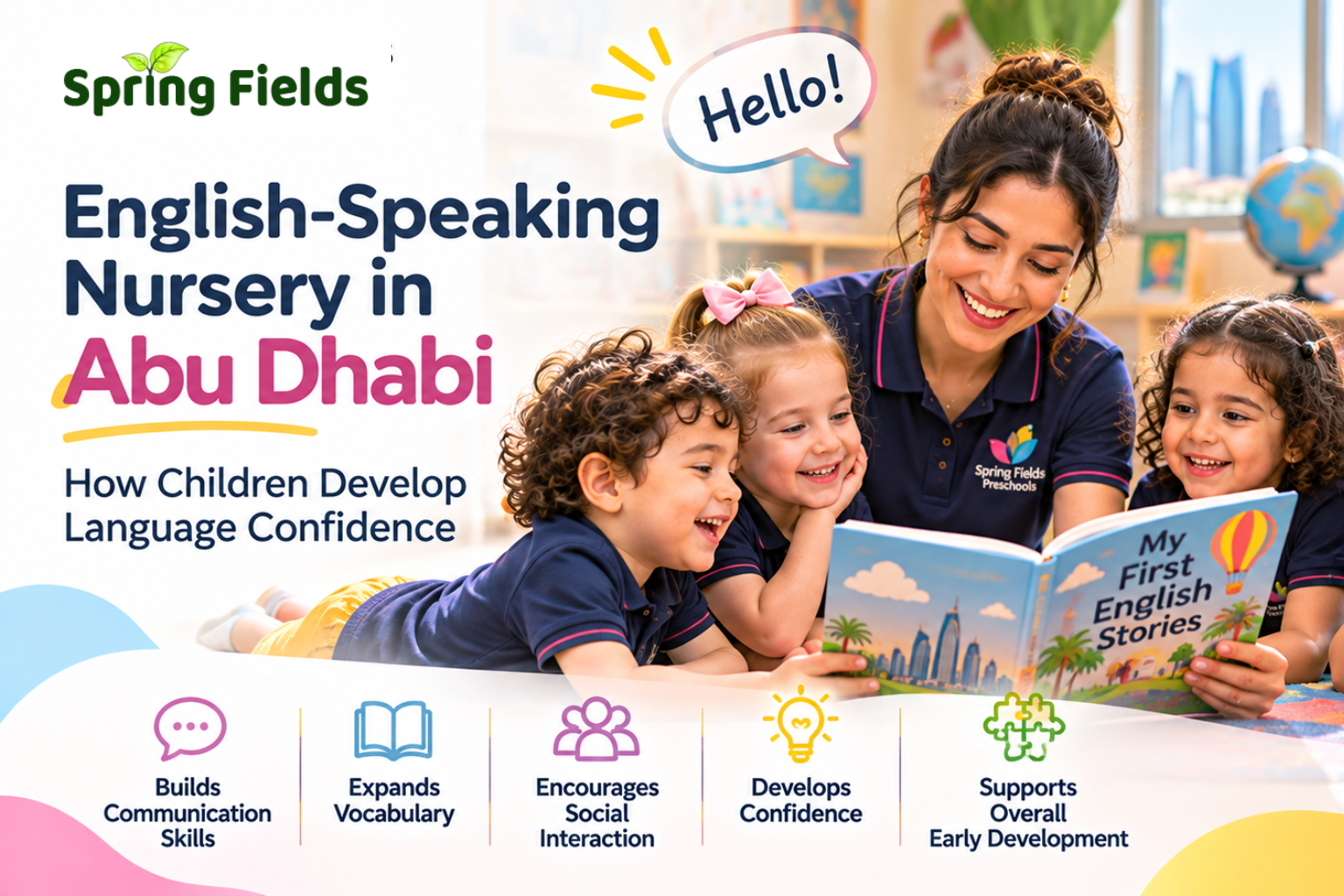
Storytelling introduces children to new words, sentence structures and ideas.
Picture books also help children connect spoken words with images.
Educators can encourage participation by asking children to identify objects, describe characters and predict what might happen next.
Parents can continue this experience at home by reading together regularly.
3. Songs, rhymes and repetition
Songs and nursery rhymes make language enjoyable.
Repetition helps children become familiar with sounds, rhythms, common expressions and new vocabulary.
Simple action songs also combine language with movement, helping children connect words with physical experiences.
4. Learning through play
Play creates natural opportunities for communication.
During pretend play, building activities, role-play and group games, children can practise describing objects, expressing preferences and interacting with others.
For example, a pretend shop activity may introduce words such as “buy”, “sell”, “money”, “basket” and “thank you”.
Children are more likely to understand language when they can connect it with something they are doing.
5. Group activities
Circle time, music sessions and collaborative activities give children opportunities to listen and communicate in a group.
They gradually become familiar with taking turns, following simple instructions and expressing their ideas.
These experiences can also help children become more comfortable speaking in front of others.
6. Visual learning resources
Pictures, objects, flashcards and classroom displays can help children connect words with their meanings.
For younger children, visual support is particularly useful because they may understand an object before they can say its name.
A picture of an apple, for example, can be used to introduce its name, colour, shape and other descriptive words.
7. Positive encouragement
Children need to feel comfortable making mistakes when learning a language.
Educators can encourage communication by listening patiently, responding positively and modelling correct expressions naturally.
If a child uses an incomplete sentence, an educator can respond with a complete version without making the child feel embarrassed.
Confidence grows when children feel that their attempts to communicate are valued.
4. What Is the Difference Between Learning English and Becoming Fluent?
Learning English is a gradual process. Fluency does not develop simply because a child attends an English-speaking environment.
Children move through different stages, and their progress can vary.
| Stage | What parents may notice |
|---|---|
| Listening and observing | Recognising familiar words, voices and instructions |
| Understanding | Responding to simple questions and everyday language |
| Using familiar words | Naming objects and expressing basic needs |
| Combining words | Beginning to use short phrases and sentences |
| Expanding vocabulary | Describing experiences and asking questions |
| Developing confidence | Participating in conversations and group activities |
These stages are not a fixed timetable. Children may understand more than they can express, and their communication abilities can develop unevenly.
Parents should focus on meaningful progress rather than comparing their child’s vocabulary with that of other children.
5. How Does the EYFS Framework Support Language Development?
The British Early Years Foundation Stage (EYFS) framework places communication and language among its three prime areas of learning.
The other two prime areas are:
- Physical development.
- Personal, social and emotional development.
These areas support children’s early development and provide foundations for the four specific learning areas: literacy, mathematics, understanding the world, and expressive arts and design.
Communication and language development includes three important elements.
Listening, attention and understanding: Children learn to listen, pay attention to others and understand spoken language.
Speaking: Children gradually develop the vocabulary and confidence to express ideas, feelings and needs.
Interaction: Everyday conversations and relationships provide opportunities to practise communication.
The framework emphasises that learning areas are connected. For example, a child describing a drawing is practising language while also exploring creativity.
At Spring Fields Preschools, the learning programme follows the British EYFS framework and uses purposeful play and age-appropriate experiences to support children’s development.
Parents can learn more about the official EYFS framework through the UK Department for Education’s Early Years Foundation Stage guidance.
Note: The UK EYFS statutory framework applies to early-years providers in England. SFN describes its educational approach as following the British EYFS framework in its Abu Dhabi setting.
6. Should Parents Stop Speaking Their Mother Tongue at Home?
No. Parents do not need to stop speaking their home language to help a child develop English.
A child’s first language is an important part of family communication, cultural identity and emotional connection.
Families in Abu Dhabi may use several languages in everyday life. A child might hear one language from parents, another from grandparents and English in a nursery environment.
Multilingual experiences are a normal part of growing up in an international community.
Parents can support language development by:
- Speaking naturally in the language they are most comfortable using.
- Reading stories in different languages.
- Encouraging conversations at home.
- Singing familiar songs and rhymes.
- Giving children time to express themselves.
- Avoiding pressure to translate every word.
A strong foundation in communication and language at home can complement a child’s experiences in an English-speaking nursery.
The goal should be confident communication, not replacing one language with another.
7. What Should Parents Look for in an English-Speaking Nursery in Abu Dhabi?
Not every nursery approaches language development in the same way.
Before enrolling your child, consider the following factors.
Educator-child interaction
Observe how educators speak with children.
Do they listen carefully, ask questions and encourage children to respond? Are conversations warm and age-appropriate?
Opportunities for communication
Ask how often children participate in storytelling, songs, group activities, conversations and imaginative play.
Age-appropriate learning
A baby, toddler and four-year-old will have different communication needs.
The activities should reflect the child’s age and developmental stage.
Support for different language backgrounds
Ask how educators support children who are new to English or primarily speak another language at home.
Parent communication
Find out how the nursery shares information about language development, classroom participation and individual progress.
A positive learning environment
Children should feel comfortable trying new words, asking questions and expressing themselves without fear of making mistakes.
A nursery visit can help parents understand how language is used throughout the day.
8. Simple Activities Parents Can Use to Build English Confidence at Home
Language development does not stop when children leave nursery. Everyday family activities provide valuable opportunities to practise communication.
Here are six simple ideas.
Read a short story together
Choose picture books and talk about the characters, objects and events.
Describe everyday activities
Talk about what you are doing while cooking, shopping, walking or getting ready.
Play naming games
Ask your child to identify familiar objects, colours, animals and household items.
Encourage pretend play
Play shopkeeper, doctor, teacher or restaurant. Let your child take the lead in conversations.
Sing familiar songs
Simple songs and rhymes introduce repetition, rhythm and new vocabulary.
Ask open-ended questions
Instead of asking only “Did you enjoy nursery?”, try asking “What did you play with today?” or “Who did you sit beside?”
Allow your child time to respond. Avoid correcting every sentence.
Small, consistent conversations can make language practice part of everyday family life.
9. How Spring Fields Preschools Supports Early Language Development
Spring Fields Preschools in Abu Dhabi provides early childhood care and education for children from 2 months to 4 years.
Its learning programme follows the British EYFS framework and uses purposeful play, exploration and age-appropriate activities to encourage children’s communication, creativity, independence and overall development.
The nursery currently lists the following class groups:
- Toddler Class: 1–2 years.
- Nursery Class: 2–3 years.
- F-S1 Class: 3–4 years.
Children at different stages need different opportunities to develop communication skills.
Younger children benefit from familiar words, songs, responsive interaction and sensory experiences. Older children can gradually participate in storytelling, group conversations, imaginative play and activities that encourage more complex expression.
Spring Fields’ approach places importance on creating learning experiences where children can explore, interact and develop confidence.
Parents considering an English-speaking nursery in Abu Dhabi can visit the nursery and discuss its classroom language environment, learning activities and age-specific programmes with the team.
10. Helping Your Child Become a Confident Communicator
Language development is not a race to learn the largest number of words.
A child who confidently asks for help, expresses an idea, describes an experience or joins a conversation is developing important communication skills.
The right nursery environment can support this journey by making language part of everyday learning.
Through stories, songs, conversations, play and positive interactions, children gradually discover that communication helps them understand the world and connect with the people around them.
Explore Early Learning at Spring Fields Preschools
Looking for an English-speaking nursery in Abu Dhabi? Contact Spring Fields Preschools to learn more about its British EYFS-based approach, class groups and current admission availability.
Address: No. 48, Al Falah Sector, East 18/3, Najda Street, behind Burjeel Hospital, Al Danah, Abu Dhabi.
Phone: 02 622 0130 | 056 853 1555
Email: administration@springfieldspreschools.com
Website: https://springfieldspreschools.com/
Frequently Asked Questions
1. What is an English-speaking nursery in Abu Dhabi?
An English-speaking nursery provides an early learning environment where English is used in everyday classroom communication, activities and interactions. Parents should confirm the actual language provision offered by each nursery.
2. Does my child need to know English before joining a nursery?
No. Children can begin nursery without speaking English fluently. They can gradually become familiar with the language through conversations, stories, songs, play and interactions with educators.
3. How do nurseries help children learn English?
Nurseries can support English language development through storytelling, songs, group activities, everyday conversations, visual resources and purposeful play.
4. Should I speak English at home if it is not my first language?
No. Parents should communicate naturally in the language they are most comfortable using. Reading, talking and interacting regularly at home can support overall language development.
5. What is the role of EYFS in language development?
The EYFS framework identifies communication and language as one of its three prime areas of learning. It supports listening, understanding, speaking and interaction through meaningful early learning experiences.
6. How long does it take a child to become comfortable speaking English?
There is no fixed timeline. Progress depends on factors such as age, previous language exposure, opportunities for interaction and individual development. Some children begin using familiar words quickly, while others need more time.
7. Does Spring Fields Preschools follow the British EYFS framework?
Yes. Spring Fields states that its learning programme follows the British Early Years Foundation Stage framework and uses purposeful play and age-appropriate experiences to support children’s development.