

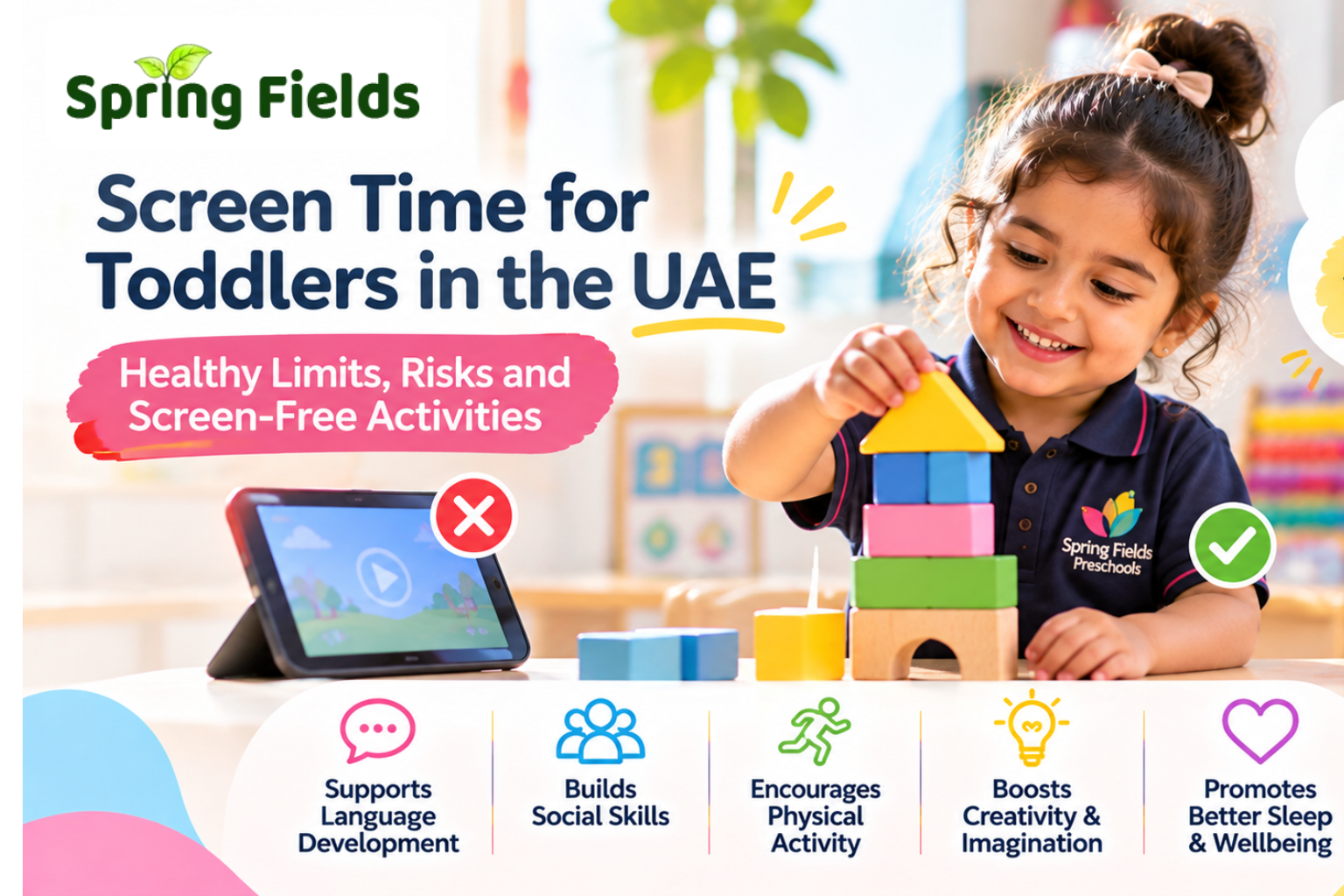
Screen Time for Toddlers in the UAE: Healthy Limits, Risks and Screen-Free Activities
Screens have become part of everyday family life. Children see smartphones during meals, watch cartoons while travelling and sometimes use tablets to stay occupied at home. For busy parents, these devices can feel like a convenient solution. But how much screen time is appropriate for toddlers and preschoolers?
Understanding screen time for toddlers in the UAE is important because the early years are a crucial period for language, movement, social interaction and emotional development. The goal is not necessarily to eliminate technology from family life. It is to create a healthy balance between digital entertainment and real-world experiences.
How Much Screen Time Should Toddlers Have?
The World Health Organization (WHO) provides age-based recommendations for sedentary screen time among children under five.
According to its guidelines:
- Under 1 year: Sedentary screen time is not recommended.
- 1 year old: Sedentary screen time is not recommended.
- 2 years old: No more than one hour per day. Less is better.
- 3–4 years old: No more than one hour per day. Less is better.
These recommendations refer to time spent sitting and watching screens, rather than active movement or physical play.
Parents should remember that these are guidelines, not a reason to panic over an occasional longer viewing session. Consistent habits matter more than one isolated day.
The Abu Dhabi Early Childhood Authority also provides guidance for parents on healthy technology use, encouraging families to set limits, monitor content and lead by example.
Why Excessive Screen Time Can Be a Concern
Young children learn by interacting with people and exploring their surroundings. When screens regularly replace these experiences, important opportunities for development may be reduced.
Here are some areas parents should pay attention to.
1. Language and Communication
Children develop language through conversations, listening, imitation and interaction.
Watching videos does not provide the same two-way communication as speaking with a parent, teacher or another child. Everyday conversations help children learn new words, understand instructions and express their needs.
2. Sleep and Daily Routines
Long or poorly timed screen sessions can interfere with a child’s bedtime routine. Exciting content may also make it harder for some children to settle down.
A consistent bedtime routine, quiet activities and keeping devices away from the sleeping area can help create healthier habits.
3. Physical Activity
Children need opportunities to walk, run, jump, climb and explore.
Long periods spent sitting with a device can replace active play. Physical movement supports coordination, balance, strength and general wellbeing.
4. Social and Emotional Development
Playing with other children teaches important skills such as sharing, waiting, taking turns and understanding emotions.
These experiences happen through real interactions. They cannot be fully replaced by watching videos or playing games alone.
Practical Ways to Reduce Screen Time at Home
Reducing screen time does not have to mean creating a strict or complicated routine. Small changes can make a difference.
Create Screen-Free Times
Choose specific parts of the day when devices are not used.
For example:
- During family meals.
- Before bedtime.
- During outdoor play.
- While reading stories together.
Consistency helps children understand what to expect.
Avoid Using Screens as the Default Distraction
It is tempting to hand a child a phone whenever they become restless. However, children also need opportunities to experience boredom, explore their surroundings and find activities independently.
Offer a toy, book or simple activity before reaching for a screen.
Watch Together When Screens Are Used
If your child watches a video, try watching together.
Talk about what is happening. Ask simple questions. Connect the content to real-life objects and experiences.
This makes screen use more interactive than passive viewing.
Set a Good Example
Children observe adult behaviour. If parents frequently use phones during conversations, meals or family activities, children may naturally copy those habits.
Try creating device-free family time and giving children your full attention.
7 Screen-Free Activities for Toddlers and Preschoolers
Children do not need expensive toys or complicated activities to stay engaged. Everyday household objects and simple play experiences can encourage curiosity and creativity.
1. Storytelling and Picture Books
Read picture books together. Point to objects, describe colours and encourage your child to name familiar things.
This supports vocabulary, listening and imagination.
2. Building Blocks
Give children age-appropriate building blocks and let them create their own structures.
Building and stacking help develop coordination, problem-solving and spatial awareness.
3. Drawing and Colouring
Offer crayons, large sheets of paper and age-appropriate colouring activities.
Children can explore colours, shapes and creative expression while developing fine motor skills.
4. Music and Movement
Play simple songs and encourage children to clap, dance, march or follow easy movements.
Music and movement provide opportunities to develop rhythm, coordination and listening skills.
5. Sorting Everyday Objects
Use safe, age-appropriate objects to practise sorting by colour, shape or size.
For example, children can group large blocks or sort suitable toys into different baskets. Always supervise young children and avoid small objects that may present a choking risk.
6. Pretend Play
Encourage children to play shopkeeper, doctor, teacher or chef using safe toys and props.
Pretend play helps children explore everyday situations, practise communication and use their imagination.
7. Outdoor Exploration
Take children outdoors when conditions are suitable. Let them observe leaves, flowers, clouds and other things around them.
Outdoor experiences encourage curiosity and provide opportunities for movement and discovery. In Abu Dhabi’s warmer months, choose suitable cooler times and ensure children stay hydrated and protected from the sun.
How Nurseries Can Support a Healthy Balance
Early childhood education provides opportunities for children to learn through interaction, exploration and hands-on activities.
A balanced early learning environment gives children opportunities to:
- Communicate with teachers and other children.
- Participate in creative activities.
- Explore age-appropriate learning materials.
- Develop physical coordination through movement.
- Practise sharing and cooperation.
- Build confidence through everyday experiences.
At Springfield Preschools Abu Dhabi, children from two months to four years are welcomed into an early learning environment guided by the British Early Years Foundation Stage (EYFS) framework.
The early years are about more than learning letters and numbers. Everyday experiences, meaningful interactions and opportunities to explore all contribute to a child’s development.
Parents can learn more about Springfield’s classes and age groups.
Frequently Asked Questions
How much screen time is suitable for a two-year-old?
WHO guidance recommends no more than one hour of sedentary screen time per day for two-year-olds. Less is better.
Should babies watch mobile phones or television?
WHO guidance does not recommend sedentary screen time for infants under one year. Interactive play, talking, singing and reading with caregivers are better alternatives.
Does educational content make screen time completely safe?
Educational content can be more beneficial than unsuitable entertainment, particularly when an adult watches and interacts with the child. However, educational content does not remove the need to manage total screen time.
What can I do when my toddler demands a phone?
Stay consistent with your screen-time boundaries. Offer alternatives such as picture books, blocks, drawing, music or pretend play. Give your child time to become interested in the new activity.
How can a nursery support children’s development without relying on screens?
A nursery can provide opportunities for storytelling, creative play, physical activities, communication and social interaction. Parents can ask the nursery about its daily routines and how technology is used in the learning environment.
Give Your Child More Opportunities to Explore
Technology is part of modern life, but it should not replace the experiences that make early childhood meaningful. Conversations, stories, movement, friendships and hands-on exploration all help children understand the world around them.
By creating balanced routines at home and choosing a nurturing early learning environment, parents can help children build healthy habits from the beginning.
Explore Springfield Preschools Abu Dhabi to learn more about its early years programmes.