

Inclusive Nursery Abu Dhabi: What Parents Should Look For Before Enrolling
Choosing an inclusive nursery in Abu Dhabi is about much more than finding a place that says “every child is welcome.”
For parents, inclusion should mean something practical.
It should mean that children with different abilities, developmental profiles, communication styles, learning needs and personalities are given meaningful opportunities to participate, learn, play and build relationships.
Abu Dhabi has made inclusion an explicit part of its early education framework. ADEK’s Early Education Institutions Inclusion Policy establishes a framework intended to ensure that children with additional learning needs receive equitable and quality education.
That makes inclusion an important question for every nursery-searching parent — not only families who already know that their child needs additional support.
So what does an inclusive nursery in Abu Dhabi actually look like?
And what should parents ask before enrolling?
What Does an Inclusive Nursery Mean?
Inclusion does not simply mean placing children with different needs in the same classroom.
A genuinely inclusive nursery tries to ensure that children can participate meaningfully in the everyday life of the setting.
That can involve adapting:
- Activities
- Communication
- Classroom layouts
- Routines
- Learning materials
- Expectations
- Adult support
- Transitions
- Social opportunities
The exact support required will depend on the individual child.
One child may need additional visual cues.
Another may benefit from more time to complete an activity.
Another may need changes to the physical environment.
Another may require specialist support.
The important principle is that children should not all be expected to learn, communicate or participate in exactly the same way.
ADEK describes inclusive education as a framework designed to provide children with additional learning needs equitable access to quality education.
Why Inclusion Matters in the Early Years
The nursery years are an especially important time for social and developmental learning.
Children are learning how to:
- Communicate
- Play alongside others
- Form relationships
- Express emotions
- Follow routines
- Become independent
- Solve problems
- Participate in groups
- Respond to differences
An inclusive environment gives children opportunities to experience those things together.
This benefits children who require additional support, but it can also benefit the wider group.
Children can learn that people communicate differently.
They can discover that some people need more time.
They can learn to cooperate.
They can develop patience and empathy.
And they can become comfortable with differences rather than treating them as something unusual.
Inclusion Is Not the Same as “Treating Everyone the Same”
This is one of the most important things parents should understand.
Imagine a nursery activity where children are asked to complete a puzzle.
Giving every child exactly the same puzzle and exactly the same amount of time might look equal.
But it isn’t necessarily equitable.
One child may need:
- Larger pieces
- Additional visual guidance
- More time
- Adult prompting
- A quieter space
- A different way of participating
Equality means giving everyone the same thing.
Equity means recognising that different children may need different support to participate meaningfully.
ADEK’s inclusion framework reflects this broader approach to supporting children with additional learning needs.
For parents, this distinction is worth discussing during a nursery visit.
Who Benefits From an Inclusive Nursery?
The phrase “additional learning needs” can sometimes make parents assume that inclusion only concerns children with a formal diagnosis.
It is broader than that.
ADEK defines additional learning needs as needs that can require extra support, modifications or accommodations within an educational setting, whether temporarily or permanently. This includes Students of Determination as well as other barriers to learning, access or interaction.
A child might need additional support because of differences involving:
- Communication
- Language
- Physical development
- Sensory processing
- Learning
- Social interaction
- Emotional regulation
- Attention
- Mobility
- Temporary circumstances
That doesn’t mean parents should attempt to diagnose their child.
It simply means that children can need different kinds of support at different points in their development.
What Should Parents Look for in an Inclusive Nursery in Abu Dhabi?
The word “inclusive” on a website isn’t enough.
When you visit a nursery, look at what actually happens.
Here are the questions worth asking.
1. Does the nursery have an inclusion policy?
This is one of the simplest questions.
Ask to see or understand the nursery’s approach to inclusion.
ADEK has a specific Inclusion Policy for Early Education Institutions, and its broader early education policy framework includes learning and development, observations and assessment, parent communication, physical environment and other areas that contribute to a supportive learning environment.
A nursery should be able to explain how its own practices fit within the applicable requirements.
2. How does the nursery identify individual needs?
Observation is an important part of early childhood education.
Teachers see children participating in:
- Play
- Group activities
- Conversations
- Physical activities
- Routines
- Creative experiences
- Social situations
Those observations can help educators understand how individual children are progressing.
ADEK has a dedicated Observations and Assessment Policy for Early Education Institutions, recognising observation and assessment as part of the early learning framework.
Ask:
“How do teachers share observations about my child’s development with parents?”
That question can reveal a lot about the nursery’s approach.
3. How Does the Nursery Adapt Activities?
Don’t just ask:
“Do you support children with additional needs?”
Ask for an example.
For instance:
“If a child finds a group activity difficult, what would the teacher do?”
A thoughtful answer might involve adapting:
- The instructions
- The materials
- The duration
- The environment
- The level of adult support
- The way the child communicates
The exact strategy should depend on the individual child.
There shouldn’t be a single “special needs activity” that every child receives.
4. Is the Classroom Environment Accessible?
Look around during your nursery visit.
Ask yourself:
Can different children participate in this environment?
Consider:
- Space between furniture
- Access to learning materials
- Noise levels
- Visual organisation
- Safe movement
- Outdoor access
- Quiet areas
- Clear routines
- Age-appropriate resources
ADEK has a specific Physical Environment Policy for Early Education Institutions, alongside policies covering child supervision and safety.
The environment is part of inclusion.
Sometimes a small environmental change can make participation much easier.
5. How Do Teachers Handle Communication Differences?
Communication is not limited to spoken language.
Young children may communicate through:
- Words
- Gestures
- Facial expressions
- Pointing
- Visual cues
- Actions
- Behaviour
A child who doesn’t immediately answer a question isn’t necessarily refusing to communicate.
They may need:
- More processing time
- Simpler language
- Visual support
- Repetition
- Another communication method
Ask the nursery:
“How do educators support children who communicate differently?”
This is particularly important in Abu Dhabi’s multilingual environment, where children may already be navigating more than one language.
6. What Happens During Group Activities?
Group time can be challenging for some children.
A child may struggle with:
- Sitting still
- Waiting
- Listening for extended periods
- Processing instructions
- Noise
- Crowded spaces
That doesn’t necessarily mean the child cannot participate.
An inclusive approach might allow different ways of engaging.
The child may sit in a different position.
They may receive additional prompts.
They may participate for shorter periods initially.
The goal is not always identical behaviour.
The goal is meaningful participation.
7. How Does the Nursery Work With Parents?
This may be one of the most important questions of all.
Parents know their children in ways educators don’t.
Educators see the child in a group environment.
Good communication between both sides can provide a much fuller picture.
ADEK has a specific Parent Engagement and Communication Policy for Early Education Institutions.
Ask:
- How often do teachers update parents?
- How are concerns communicated?
- Can parents share strategies that work at home?
- How are developmental observations discussed?
- Who should parents speak to if they have concerns?
Inclusion works best when parents and educators work as partners.
Early Identification Can Make a Difference
One of the reasons early childhood education matters so much is that educators may notice developmental patterns while children are still very young.
That doesn’t mean nursery teachers should diagnose children.
They shouldn’t.
But they can observe.
They may notice that a child:
- Rarely responds to communication
- Has difficulty participating in certain routines
- Needs substantially more support with particular tasks
- Struggles with certain types of interaction
- Shows an unusual pattern of development
A responsible nursery should communicate observations appropriately and encourage parents to seek professional guidance where necessary.
Abu Dhabi’s Early Childhood Authority has also highlighted the importance of early childhood intervention and family participation, describing approaches that are child-centred, family-centred, culturally and linguistically competent, community-based and inclusive.
The earlier a concern is understood, the more opportunity families may have to seek appropriate support.
An Inclusive Nursery Should Not Try to Diagnose Your Child
This distinction is important.
A nursery can:
Observe → document → communicate → support → collaborate.
It should not casually:
Diagnose → label → make medical conclusions.
If educators have concerns, parents may be encouraged to discuss them with an appropriate healthcare or developmental professional.
ADEK’s system also provides specialist pathways and support for Students of Determination and children with additional learning needs, including access to services such as speech and language therapy, psychotherapy and occupational therapy through relevant arrangements.
Parents should therefore see a nursery as one part of a wider support network, rather than expecting nursery teachers to provide every specialist service themselves.
What Is the Difference Between Inclusion and Specialist Provision?
Not every child requires the same educational setting.
ADEK’s framework includes mainstream inclusion as well as specialised provisions for eligible children whose needs require services beyond what mainstream settings can appropriately provide.
This is why parents should avoid making assumptions.
An inclusive nursery may be appropriate for one child but not necessarily for another.
The question should always be:
“What environment is appropriate for my child’s individual needs?”
That answer may involve the nursery, parents and qualified professionals working together.
Inclusion Doesn’t Mean Lowering Expectations
Another common misconception is that supporting a child means expecting less from them.
It doesn’t.
An educator can maintain meaningful learning goals while changing how a child reaches them.
For example, the goal might be:
Participate in a story.
One child might sit and listen.
Another might look at picture cards.
Another might answer verbally.
Another might point to characters.
The learning experience can be adapted without assuming that the child is incapable of participating.
That is the difference between supporting access and simply lowering expectations.
Inclusion and Play-Based Learning
Play is particularly useful because it offers multiple ways for children to participate.
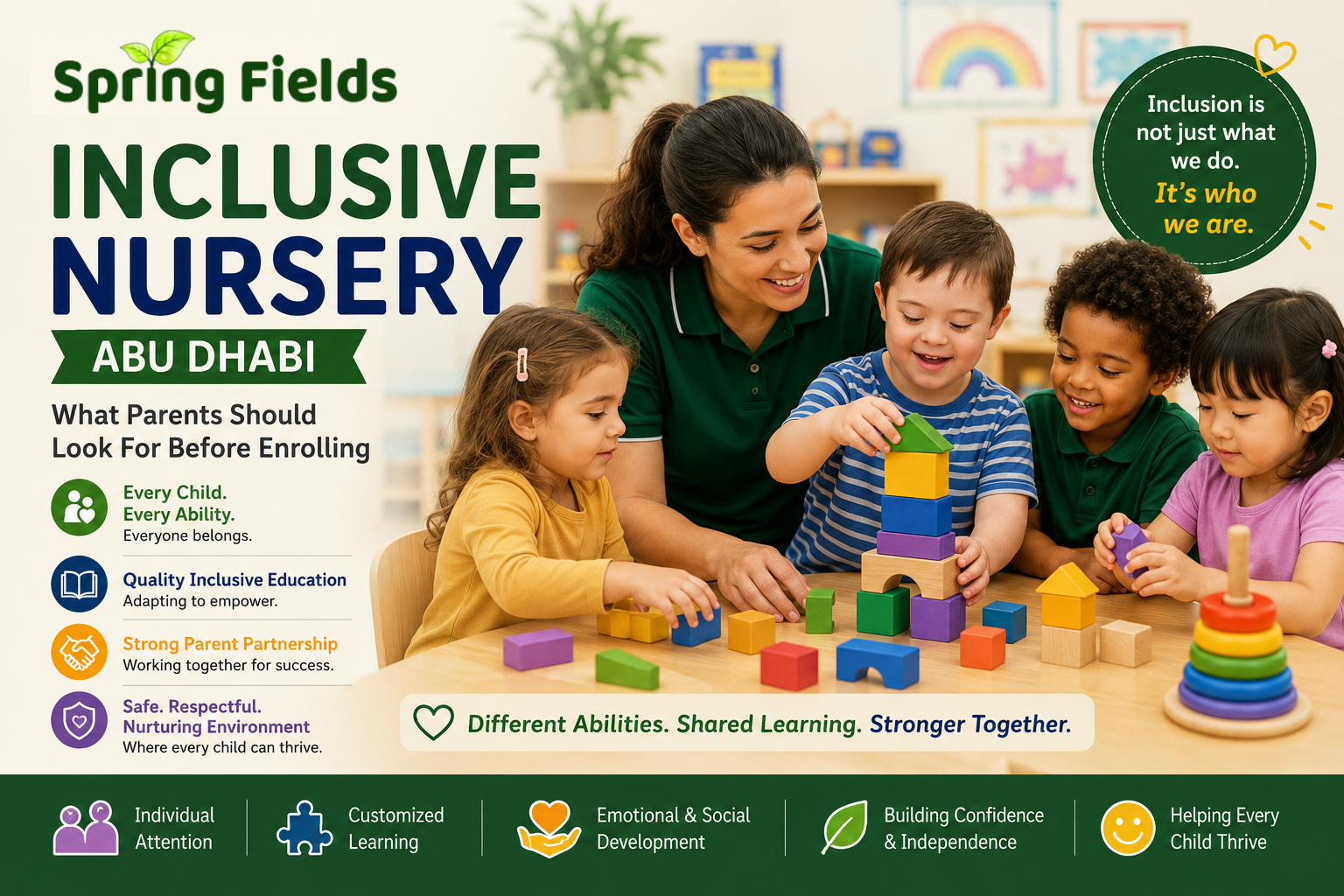
A block-building activity can involve:
- Building
- Sorting
- Talking
- Watching
- Imitating
- Collaborating
- Exploring
Children don’t have to participate in exactly the same way.
An educator can adjust the activity while maintaining the same broad learning opportunity.
This fits naturally with the EYFS approach used at Spring Fields.
Spring Fields describes its British EYFS-based programme as play-based, with experiences designed to support communication, creativity, independence, physical development and social development.
Its classrooms are organised with age-appropriate resources and areas that allow children to explore and investigate independently.
How Spring Fields Approaches Every Child’s Individual Development
At Spring Fields Preschools in Abu Dhabi, the nursery describes its philosophy around each child’s individual journey, with a focus on emotional, social, physical and intellectual development.
Its programme follows the British EYFS framework and uses play-based experiences to develop communication, creativity, independence and early learning.
Spring Fields currently lists:
- Toddler Class: ages 1–2
- Nursery Class: ages 2–3
- F-S1 Class: ages 3–4
The nursery states that children can explore age-appropriate areas independently within a safe environment, with classrooms equipped with selected resources and toys.
For parents considering an inclusive nursery in Abu Dhabi, the most useful next step is not to assume that a website can answer every question about an individual child.
Instead, discuss your child’s needs directly with the nursery team.
You can explore Spring Fields’ nursery classes and learn more about its British EYFS approach.
10 Questions to Ask an Inclusive Nursery Before Enrolling
Take this list with you when visiting.
1. What does inclusion mean at your nursery in practical terms?
2. Do you have an inclusion policy that parents can review?
3. How do educators identify and document individual learning needs?
4. How are activities adapted when a child needs additional support?
5. How do you support children with communication differences?
6. How do you handle sensory or environmental needs?
7. How do you communicate developmental observations with parents?
8. What happens if educators have concerns about a child’s development?
9. Do you work with external specialists where appropriate?
10. Who should parents speak to if they need additional support?
A nursery that can answer these questions clearly is giving parents something much more useful than a generic statement saying:
“We welcome every child.”
What Parents Should Observe During a Nursery Visit
Don’t spend the entire visit listening to the sales presentation.
Watch the children.
Are educators:
- Getting down to the children’s level?
- Listening to them?
- Giving them time to respond?
- Encouraging communication?
- Supporting children through frustration?
- Allowing children to explore?
- Helping children interact with one another?
- Adapting when something isn’t working?
Look at the physical environment too.
Is there enough space?
Are resources accessible?
Can children move around safely?
Are there different kinds of activities available?
Does the room feel calm enough for children to engage?
The everyday environment often tells you more about a nursery than a brochure.
Inclusion Is Also About Belonging
There is an important difference between being present and belonging.
A child can physically be in a classroom without feeling included.
True inclusion is about participation.
Can the child join the game?
Can they communicate with the educator?
Can they access the activity?
Can they form friendships?
Can they contribute?
Can they develop independence?
Can they feel that they are a valued part of the group?
Abu Dhabi’s Early Childhood Development Strategy 2035 includes goals around creating safe, family-friendly environments, strengthening support for parents and caregivers, nurturing positive cultural identity and social cohesion, and building a capable early childhood workforce.
That broader vision reinforces an important point:
Early childhood development isn’t only about what happens during a lesson.
It is about the environment surrounding the child.
Inclusion Is Good Early Education
Ultimately, parents should not think of inclusion as a completely separate category from quality early education.
Many of the things that make a nursery supportive for a child who learns differently also make it better for children generally.
For example:
Clear routines help children who need predictability — and help many toddlers feel secure.
Visual resources can support communication — and can make activities easier for everyone to understand.
Flexible activities can accommodate different abilities — and give every child more ways to explore.
Responsive educators support children who need additional guidance — while strengthening relationships with the whole class.
Strong parent communication is valuable for every family.
Inclusion can therefore be part of a nursery’s overall culture of responsive, child-centred education.
Final Thoughts for Abu Dhabi Parents
Choosing an inclusive nursery in Abu Dhabi shouldn’t come down to whether a nursery uses the word “inclusive” on its website.
Look deeper.
Ask how children are supported.
Ask how educators observe development.
Ask how activities can be adapted.
Ask how parents are involved.
Ask how communication differences are handled.
Ask what happens when a child needs additional support.
And, most importantly, visit the nursery and observe the environment yourself.
Abu Dhabi has established a clear policy framework around inclusion in early education, with ADEK stating that children with additional learning needs should receive equitable and quality education.
At the same time, ADEK’s wider education system provides mainstream inclusion, specialist services and family support pathways for Students of Determination and children with additional learning needs.
For families, this means inclusion should be approached as a partnership.
Parents know their child.
Educators understand the learning environment.
Specialists can provide professional expertise when required.
And the child remains at the centre.
The best early-years environment isn’t necessarily the one that promises to make every child learn in exactly the same way.
It is the one that understands that children are different — and gives each child a meaningful opportunity to learn, participate, develop and belong.
Frequently Asked Questions
What is an inclusive nursery in Abu Dhabi?
An inclusive nursery in Abu Dhabi is an early education setting that provides equitable opportunities for children with different abilities and additional learning needs to participate in learning, play and social experiences. ADEK has a specific Inclusion Policy for Early Education Institutions.
Does inclusive nursery mean the child needs a diagnosis?
No. Additional learning needs can involve children who require extra support, modifications or accommodations temporarily or permanently. ADEK’s definition is broader than children with a formal diagnosis.
How do I know if a nursery is genuinely inclusive?
Ask the nursery how it adapts activities, supports communication differences, observes development, communicates with parents and works with specialists when appropriate. Also observe how educators interact with children during your visit.
Can a nursery diagnose developmental delays?
Nursery educators can observe children’s development and communicate concerns with parents, but parents should seek assessment or diagnosis from appropriately qualified professionals.
What support is available for Children of Determination in Abu Dhabi?
ADEK provides mainstream inclusion pathways, family support and access to specialist services, including speech and language therapy, psychotherapy and occupational therapy through relevant services and providers.
Is inclusion only about children with disabilities?
No. Inclusion can involve children with a wide range of additional learning needs or barriers to learning, access or interaction.
What should I ask a nursery about inclusion?
Ask about its inclusion policy, classroom adaptations, observation and assessment, parent communication, specialist collaboration, communication support and how individual needs are identified.
Does Spring Fields follow the EYFS?
Yes. Spring Fields states that its programme is aligned with the British Early Years Foundation Stage and uses play-based experiences to support children’s development.