
Arabic Nursery Abu Dhabi: What Parents Should Know About Arabic Learning in the Early Years
Choosing an Arabic nursery Abu Dhabi families can feel confident about is becoming an increasingly important consideration for parents who want their children to develop language skills while also building a connection with the culture and community around them.
In Abu Dhabi, Arabic is not simply another language that children may encounter at school. It can also be connected to family, heritage, identity, traditions and belonging.
At the same time, many children in Abu Dhabi grow up in multilingual households where English, Arabic and other languages are used every day.
So what should parents actually look for when choosing an Arabic nursery in Abu Dhabi?
Is learning Arabic alongside English confusing for toddlers?
Should Arabic be taught as a separate subject, or should it become part of everyday nursery life?
And how can parents support Arabic development at home?
The answers are more nuanced than simply choosing between Arabic and English.
Why Arabic Matters in Abu Dhabi’s Early Years
Abu Dhabi is a highly multicultural city, but Arabic remains central to the UAE’s cultural and national identity.
For Emirati families, Arabic may be the language of family conversations, traditions and cultural expression.
For expatriate families, learning Arabic can provide children with a stronger connection to the society in which they are growing up.
That makes the early years an interesting opportunity.
Young children are naturally exposed to language through:
- Conversations
- Songs
- Stories
- Play
- Family routines
- Social interaction
- Nursery activities
- Cultural experiences
Arabic therefore does not have to be treated as something children only learn from a textbook.
It can be part of the child’s everyday world.
Abu Dhabi’s Nursery Landscape Is Changing
There is also a significant local development that parents should know about.
In October 2025, the Abu Dhabi Department of Education and Knowledge (ADEK) introduced Al Saff Al Emirati, a dedicated classroom provision available to private nurseries.
The programme is designed for children aged 2 to 4 and provides an Arabic-led learning environment rooted in Emirati heritage, values and the mother tongue.
ADEK says the classrooms are led by Emirati educators and incorporate elements such as stories, poetry, proverbs, traditions and UAE heritage into everyday learning.
At launch, 11 private nurseries across Abu Dhabi had adopted the provision.
Importantly, ADEK states that enrolment is open to both Emirati and non-Emirati families who want their children to experience an Arabic-focused, culturally rich learning environment.
This is a useful development for parents because it demonstrates that Arabic in early childhood is increasingly being considered not only as language instruction, but also as part of identity and belonging.
What Is an Arabic Nursery?
The phrase “Arabic nursery” can mean different things.
One nursery might offer Arabic as a dedicated language activity.
Another might have Arabic-speaking educators interacting with children throughout the day.
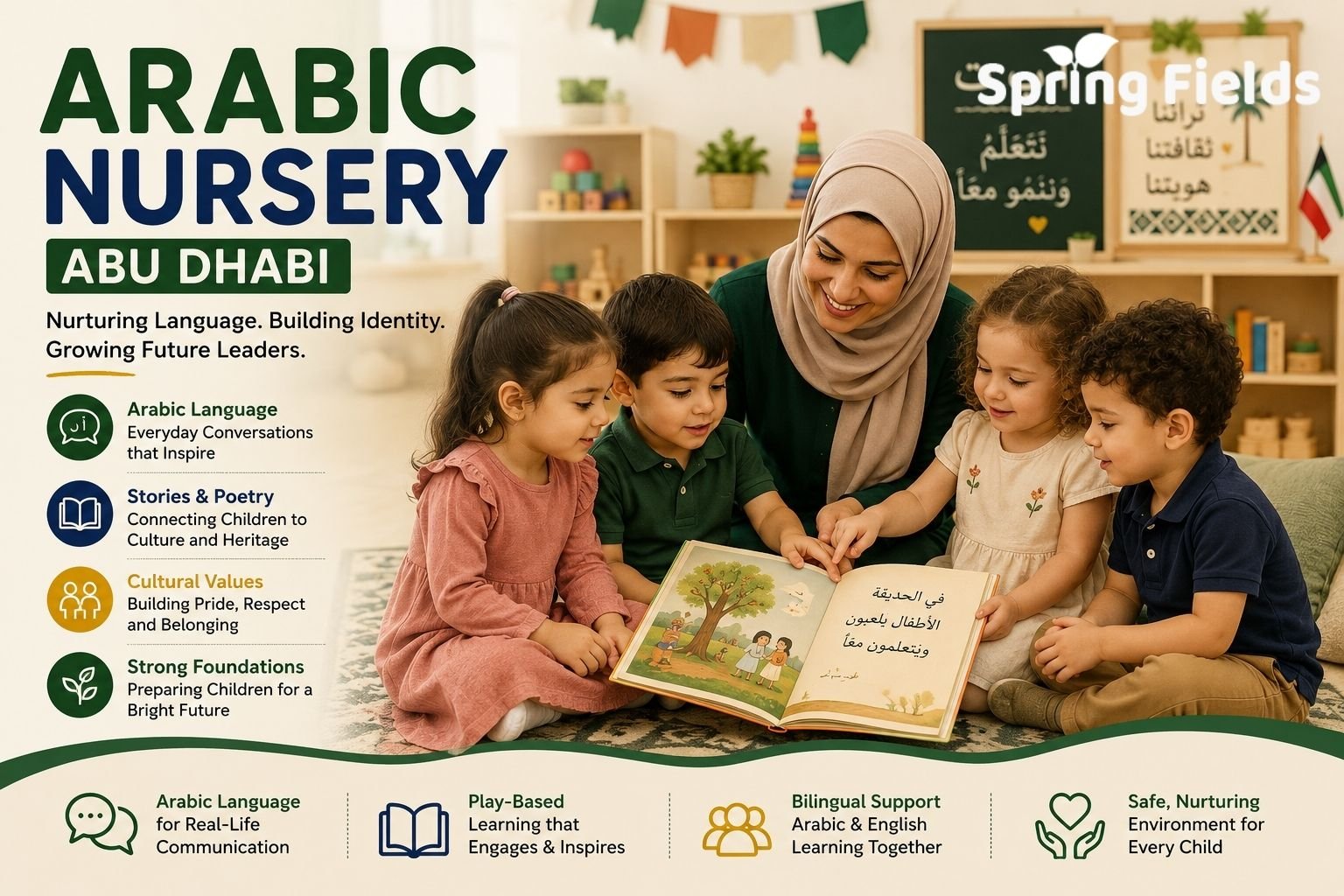
Another might provide an Arabic-led classroom where stories, songs, routines and cultural activities are delivered primarily in Arabic.
These are not necessarily the same experience.
Therefore, parents should not stop at asking:
“Do you teach Arabic?”
A much better question is:
“How is Arabic used throughout my child’s day?”
That question can reveal whether Arabic is an occasional lesson or a meaningful part of the learning environment.
Arabic Lessons vs Arabic-Rich Learning
There is an important difference between the two.
Arabic lessons
Children may spend a short period learning:
- Letters
- Numbers
- Colours
- Basic vocabulary
- Simple phrases
This can be useful.
Arabic-rich learning
Arabic becomes part of everyday experiences.
Children may hear Arabic while:
- Listening to stories
- Singing songs
- Playing
- Greeting educators
- Discussing pictures
- Participating in cultural activities
- Following routines
- Talking about family
- Exploring their environment
For very young children, the second approach can create more natural opportunities to hear and use language.
The objective isn’t necessarily to make a toddler memorise hundreds of Arabic words.
It is to make Arabic meaningful.
Can Toddlers Learn Arabic and English Together?
Yes.
Young children can develop more than one language when they receive meaningful and consistent exposure.
However, bilingual development does not mean that both languages will always develop at exactly the same speed.
A child might understand more Arabic than they speak.
Another child might speak more English because English is the language they use most frequently at nursery.
Another might use Arabic with grandparents but English with friends.
All of these contexts influence language development.
For example, a child might know more Arabic words related to:
- Family
- Food
- Home
- Relatives
- Cultural traditions
while knowing more English words related to:
- Classroom activities
- Toys
- Colours
- Shapes
- Books
- Nursery routines
Looking at only one language may therefore give parents an incomplete picture of what the child understands.
Does Learning Arabic and English Confuse Toddlers?
This is one of the biggest concerns parents have.
A child may say something like:
“Mama, I want the blue car.”
and then insert an Arabic word into the sentence.
Parents may wonder:
“Are they confused?”
Not necessarily.
Children who hear multiple languages may naturally move between them depending on:
- Who they are speaking to
- Where they are
- What they are discussing
- Which word comes most easily
- Which language they associate with a particular situation
This is commonly referred to as code-switching.
Using elements of two languages does not automatically indicate that a child is confused or experiencing a language problem.
The more important consideration is whether the child is gradually developing their ability to understand, communicate and interact.
If parents have concerns about speech or language development, they should discuss them with the child’s educator and, where appropriate, a qualified professional rather than assuming bilingualism is responsible.
Your Home Language Still Matters
One of the biggest mistakes parents can make is abandoning their strongest home language because they believe their child needs to speak more English.
If Arabic is the language you naturally speak at home, continue using it.
If another language is your family’s strongest language, continue using that language too.
Children benefit from rich, meaningful communication.
That means parents shouldn’t feel pressured to turn every conversation into a language lesson.
Talk naturally.
Tell stories.
Ask questions.
Explain what you are doing.
Listen to your child.
Sing together.
Read.
These everyday interactions are valuable.
They also allow children to develop a deeper vocabulary than they might acquire from memorising isolated words.
Arabic Can Strengthen Family Connections
Language is closely connected to relationships.
Think about a child speaking with a grandparent.
The conversation may include:
- Family stories
- Childhood memories
- Songs
- Expressions
- Jokes
- Traditions
- Cultural references
If the child can understand and participate in those conversations, language becomes more than an academic skill.
It becomes a bridge between generations.
That is one reason Arabic learning during the early years can be meaningful even for families who use English extensively.
The goal doesn’t have to be:
“My child must speak perfect Arabic.”
It can simply be:
“My child should have the opportunity to understand and connect.”
Arabic and Cultural Identity
Language and culture often develop together.
A child learning Arabic through a worksheet may learn vocabulary.
A child hearing Arabic through a story about family, community or UAE traditions is experiencing something broader.
This is exactly the direction reflected in Abu Dhabi’s Al Saff Al Emirati initiative.
ADEK describes the programme as supporting Arabic literacy while helping children develop a sense of identity, pride and connection to their culture. The provision integrates heritage, stories, poetry, proverbs and traditions into everyday learning.
That makes cultural learning particularly relevant to the early years.
What Should Parents Look for in an Arabic Nursery in Abu Dhabi?
If Arabic is important to your family, don’t choose a nursery based solely on the word “Arabic” appearing on its website.
Ask specific questions.
1. How much Arabic will my child hear?
Is Arabic used for:
- Storytelling?
- Songs?
- Conversations?
- Group activities?
- Everyday routines?
Or is it limited to one short lesson?
2. Who teaches Arabic?
Ask about the educators who will interact with your child.
Language exposure is influenced not only by the curriculum but also by the people children communicate with every day.
3. Is Arabic connected to play?
Young children learn through experiences.
Ask whether Arabic is incorporated into:
- Pretend play
- Building
- Art
- Music
- Outdoor activities
- Storytelling
Language becomes more meaningful when children have a reason to use it.
4. Does the nursery include cultural experiences?
Ask whether children experience:
- UAE stories
- Traditional songs
- Cultural celebrations
- Arabic books
- Poetry
- Local traditions
- Heritage activities
This can help children understand that Arabic is part of a living culture rather than simply a school subject.
5. How does the nursery support multilingual children?
This is especially important in Abu Dhabi.
A child may hear three or more languages across home, nursery and extended family.
Ask:
“How do you support children who are developing more than one language?”
A good answer should recognise that multilingualism can be part of the child’s everyday environment rather than treating another home language as a problem.
Arabic Through Storytelling
Storytelling is one of the easiest ways to make Arabic engaging for young children.
Instead of presenting a list of vocabulary words, a story gives children context.
A child may hear the same words repeatedly:
- Family
- House
- Food
- Animals
- Colours
- Feelings
- Actions
But now those words have meaning.
Parents can make this even more interactive by asking questions:
“Where is the cat?”
“Who is this?”
“What happened next?”
“How does she feel?”
The child doesn’t need to answer perfectly.
The interaction itself creates language exposure.
Arabic Through Songs and Rhymes
Songs are particularly useful for toddlers because repetition is naturally built into them.
A child may not understand every word the first time.
But after hearing the same song repeatedly, they begin to recognise:
- Sounds
- Rhythm
- Repeated phrases
- Vocabulary
- Patterns
Songs can also make Arabic feel enjoyable.
That matters.
A child who associates a language with warmth, music and play may develop a very different relationship with it from a child who associates it only with memorisation.
Arabic Through Play
Play provides another natural language opportunity.
Imagine a pretend kitchen.
An educator can introduce Arabic words for:
- Plate
- Cup
- Spoon
- Food
- Water
- Hot
- Cold
But the child isn’t sitting down to memorise them.
They’re using the words while playing.
The same principle can work with:
Blocks
Shapes, colours, sizes and positions.
Dolls
Family, emotions and routines.
Cars
Movement and directions.
Art
Colours, materials and actions.
Outdoor play
Nature, movement and objects.
This is why language development works particularly well when connected to the wider early-years experience.
How Parents Can Support Arabic at Home
You don’t need expensive resources.
You can start with everyday routines.
Read Arabic stories
Choose books appropriate for your child’s age.
Don’t worry if your child doesn’t understand every word.
Talk about the pictures.
Sing Arabic songs
Repetition makes language memorable.
Talk during meals
Name foods and describe what you’re doing.
Talk about family
Use Arabic when discussing grandparents, relatives and family routines.
Cook together
Introduce Arabic words for ingredients and actions.
Use Arabic during routines
Bath time, getting dressed and bedtime are excellent opportunities for repeated language.
Ask questions
Instead of simply telling your child everything, invite them to respond.
Let grandparents participate
Family members can provide natural language exposure that children may not receive elsewhere.
What If My Child Prefers English?
This is common in multilingual environments.
If your child spends several hours each day in an English-speaking nursery, English may become the language they use most frequently.
That doesn’t mean Arabic has failed.
Instead of forcing Arabic, create positive reasons to use it.
For example:
- Arabic story time with a parent
- Arabic songs
- Conversations with grandparents
- Arabic games
- Cultural activities
- Visits with Arabic-speaking family members
The objective is to create meaningful opportunities rather than turning every interaction into a test.
How Much Arabic Should a Toddler Learn?
There is no single vocabulary number that parents should use as a target.
Language development varies between children and depends on:
- Age
- Exposure
- Frequency of interaction
- Family language patterns
- Individual development
- Opportunities to communicate
- The child’s personality
Instead of asking:
“How many Arabic words does my child know?”
ask:
“Is my child increasingly understanding and communicating?”
Look for progress.
Perhaps your toddler begins recognising a familiar Arabic song.
Then they start repeating a word.
Then they respond to a simple question.
Then they use the word independently.
Those small steps matter.
Arabic, English and the Abu Dhabi Child
A child growing up in Abu Dhabi may experience a remarkable mix of languages and cultures.
They may hear Arabic from a neighbour.
English at nursery.
Another language from a grandparent.
Another language from a family friend.
That environment can be an advantage.
Children are learning that communication can happen in different ways with different people.
The role of the nursery is not necessarily to make every child’s language experience identical.
It is to provide a supportive environment where children can develop communication, confidence and curiosity.
What Does Spring Fields Offer?
Spring Fields Preschools in Abu Dhabi follows the British Early Years Foundation Stage (EYFS) approach and describes its learning philosophy around play, exploration, communication, creativity, independence and children’s overall development.
The nursery currently lists programmes for:
- Toddler Class: 1–2 years
- Nursery Class: 2–3 years
- F-S1 Class: 3–4 years
Its classrooms are designed with age-appropriate resources and areas where children can explore and investigate independently.
For parents specifically looking for an Arabic nursery in Abu Dhabi, it is important to discuss the nursery’s current Arabic-language provision directly with the admissions team rather than assuming that every programme offers the same level of Arabic exposure.
You can explore the Spring Fields nursery classes or learn more about the Spring Fields EYFS approach.
Arabic Learning Should Feel Natural
The early years are not the time to turn every experience into formal instruction.
Children learn language through relationships.
They learn when someone responds to their question.
They learn when an educator tells them a story.
They learn when a parent sings.
They learn when a grandparent shares a memory.
They learn when two children play together.
That is why the best Arabic exposure for a toddler may not look like a traditional lesson at all.
It may look like:
A story.
A song.
A game.
A conversation.
A family routine.
A cultural experience.
And that is precisely what makes early language learning powerful.
Arabic and English Can Grow Together
Parents don’t necessarily need to choose one language and postpone the other.
Arabic and English can have different roles in a child’s life.
Arabic may be connected to:
- Family
- Heritage
- Culture
- Community
- Identity
English may be connected to:
- Nursery
- Books
- International communication
- Education
- Friends
Those roles can overlap.
A child can move between them.
And as their experiences expand, their language skills can develop too.
Final Thoughts: Choosing an Arabic Nursery in Abu Dhabi
Choosing an Arabic nursery Abu Dhabi families trust should begin with a simple question:
What kind of language experience do I want my child to have?
If you want your child to learn Arabic, don’t look only for a nursery that offers an Arabic worksheet or a short weekly lesson.
Look for meaningful exposure.
Ask how Arabic is used.
Ask who speaks it.
Ask whether it appears in stories, songs, play and everyday routines.
Ask how the nursery supports multilingual children.
And ask how language connects with culture.
Abu Dhabi’s early education landscape is clearly placing greater emphasis on Arabic literacy and cultural identity. ADEK’s Al Saff Al Emirati initiative is a particularly significant example, providing an Arabic-led classroom experience for children aged 2–4 and integrating UAE heritage, stories, poetry and traditions into early learning.
For parents, this creates an opportunity to think about language earlier and more intentionally.
But don’t make bilingual development a race.
Speak naturally.
Read.
Sing.
Play.
Tell stories.
Keep your home language alive.
Give your child reasons to communicate.
Most importantly, help them associate language with people, relationships, culture and joy.
Because the goal of Arabic learning in the early years isn’t simply for a child to know more words.
It is for them to have another way to understand, connect, communicate and belong.
Frequently Asked Questions
What is an Arabic nursery in Abu Dhabi?
An Arabic nursery in Abu Dhabi may provide Arabic-language exposure through lessons, stories, songs, play, routines or an Arabic-led learning environment. The exact approach varies between nurseries, so parents should ask how much Arabic children hear and use during a typical day.
At what age should children start learning Arabic?
Children can be exposed to Arabic from infancy. There is no need to wait until school age. Everyday conversations, songs, stories and play can all provide meaningful early exposure.
Can my child learn Arabic and English at the same time?
Yes. Young children can develop more than one language when they receive meaningful and consistent exposure. The two languages may develop at different rates depending on how often and where each language is used.
Will Arabic and English confuse my toddler?
Learning two languages does not automatically confuse children. Multilingual children may sometimes use words from different languages in the same conversation. This can be a normal part of multilingual communication.
Should I speak Arabic at home if my child’s nursery uses English?
If Arabic is your strongest or most natural family language, continuing to speak Arabic at home can provide valuable language exposure and help maintain family communication.
What is Al Saff Al Emirati?
Al Saff Al Emirati is an ADEK classroom provision available to private nurseries in Abu Dhabi. Designed for children aged 2–4, it provides an Arabic-led environment rooted in Emirati heritage, values and language, incorporating stories, poetry, proverbs and traditions. ADEK launched the initiative in October 2025.
Is Al Saff Al Emirati only for Emirati children?
No. ADEK states that both Emirati and non-Emirati families can enrol their children in the provision if they want an Arabic-focused, culturally rich early-learning experience.
How can I help my toddler learn Arabic at home?
Read Arabic books, sing Arabic songs, talk during everyday routines, tell stories, involve Arabic-speaking relatives and use Arabic during play. Consistent, enjoyable interaction is more useful than turning every activity into a formal lesson.
Should Arabic be taught separately from play?
Not necessarily. Arabic can be incorporated naturally into storytelling, music, pretend play, outdoor activities, art and everyday routines. Meaningful context can make language more engaging for young children.
How do I choose the right Arabic nursery in Abu Dhabi?
Ask about the amount of Arabic exposure, who teaches it, how it is incorporated into play and routines, whether cultural learning is included, how multilingual children are supported and how parents receive updates about their child’s development.