
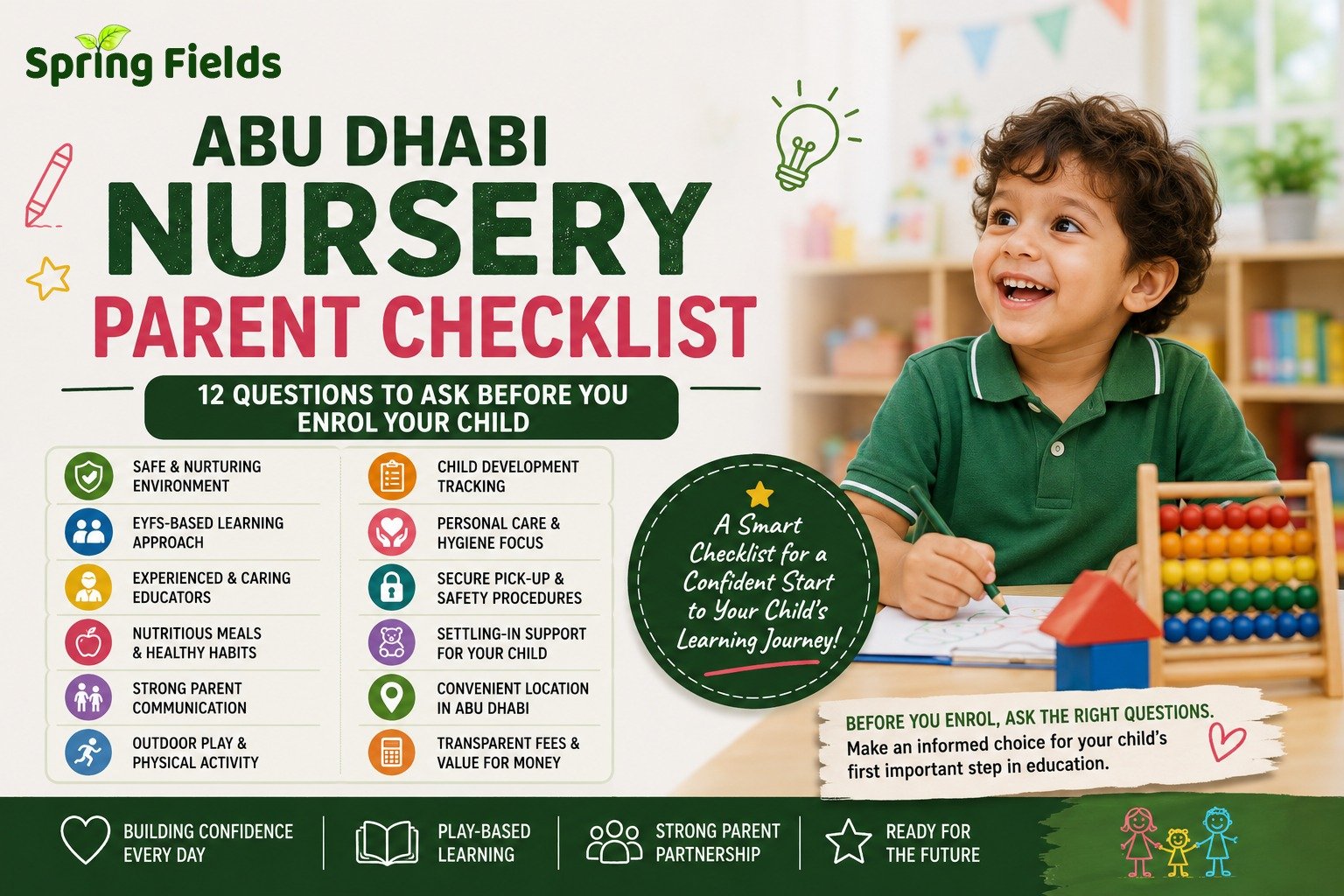
Abu Dhabi Nursery Parent Checklist: 12 Questions to Ask Before You Enrol Your Child
Choosing a nursery in Abu Dhabi is not simply about finding a place that looks attractive, has good reviews or offers a convenient fee structure.
Your child’s nursery will be one of their first experiences outside the home. It can influence how they experience separation, relationships, routines, communication, play and early learning.
And parents in Abu Dhabi have plenty of choice.
ADEK reported 233 licensed nurseries across Abu Dhabi, Al Ain and Al Dhafra in October 2025 after seven new nurseries opened across the emirate.
More choice is useful, but it also makes the decision harder.
So instead of asking only, “Which is the best nursery in Abu Dhabi?”, ask better questions.
This Abu Dhabi nursery parent checklist gives you 12 areas to evaluate before enrolling your child.
1. Is the Nursery Licensed and Properly Registered?
Start with the basics.
Before comparing classrooms, activities or fees, make sure the nursery is operating within Abu Dhabi’s regulatory framework.
ADEK states that nursery registration takes place directly with the nursery, while each nursery establishes its own admission policy within applicable laws and regulations. ADEK’s registration guidance also lists documents such as the child’s Emirates ID and birth certificate among the requirements.
Ask the nursery:
“Can I see your current licence and registration information?”
You should also ask for the nursery’s parent handbook and admission policies.
This is particularly important because ADEK has established policies covering admissions, attendance, authorised child pick-up, complaints, fees, staffing and other aspects of early education.
A nursery should be comfortable explaining these arrangements to prospective parents.
Parent checklist
Before enrolling, confirm:
- The nursery is licensed.
- You understand its admission requirements.
- You have received the relevant policies.
- You know what documents are required.
- You understand the registration process.
Do this before paying a registration fee.
2. What Curriculum and Learning Approach Does It Follow?
The word “curriculum” can mean very different things at different nurseries.
Don’t stop at asking:
“Which curriculum do you follow?”
Ask:
“What does my child actually do during the day?”
A strong early-years programme should support more than alphabet recognition and numbers.
Look for opportunities involving:
- Communication and language
- Early literacy
- Early numeracy
- Physical development
- Social development
- Emotional development
- Creativity
- Problem-solving
- Independence
- Imagination
ADEK’s current Early Education framework includes a Learning and Development Policy designed to support children’s learning and development within Early Education Institutions.
At Spring Fields Preschools, the programme follows the British EYFS approach, with age-appropriate learning experiences built around children’s developmental needs.
When you visit, ask the educator to show you an example of a normal learning activity.
That will tell you much more than a curriculum name on a brochure.
3. What Does a Typical Nursery Day Look Like?
Ask for the actual daily timetable.
A nursery may advertise:
- Art
- Music
- Outdoor play
- Storytelling
- Sensory activities
- Early mathematics
- Language development
But how much time does your child actually spend doing these things?
A typical routine may include arrival, free play, group activities, learning experiences, outdoor time, meals, rest, creative activities and storytime.
The important thing is that the day should feel predictable without becoming rigid.
ADEK’s Parent Engagement Policy requires early education institutions to provide parents with information about programme timings and daily routines, including sample timetables during parent induction.
Ask:
“Can I see the daily routine for my child’s age group?”
Also ask whether the routine changes according to the child’s age and developmental stage.
A one-year-old and a three-year-old should not necessarily experience exactly the same day.
4. How Many Children and Educators Are in the Classroom?
The number of children in a classroom matters.
So does the number of adults.
Ask:
- How many children are in the class?
- How many educators are normally present?
- Are additional staff available when needed?
- Are the same educators usually with the class?
- How are staff absences handled?
ADEK’s parent-engagement framework expects nurseries to communicate information about adult-to-child ratios for different age groups to parents.
Don’t look only for the smallest possible class.
Instead, consider whether the staffing structure allows educators to respond to children’s individual needs.
A child should be able to ask for help, receive attention and build relationships with familiar adults.
5. Who Will Actually Teach and Care for My Child?
During a nursery tour, parents often spend most of their time talking to the manager.
That is useful.
But your child will spend most of their day with educators.
Try to meet them.
Watch how they interact with children.
Do they:
- Listen patiently?
- Speak respectfully?
- Respond when children ask for help?
- Encourage children to try things independently?
- Get down to the child’s level?
- Notice when a child is uncomfortable?
- Encourage rather than constantly correct?
Also ask about staff qualifications, training and experience.
ADEK has a dedicated Staffing Policy establishing requirements around the recruitment and management of competent staff in Early Education Institutions.
A good question is:
“How long have the educators in this classroom been working with this age group?”
6. How Does the Nursery Handle Separation and Settling-In?
For many families, this is one of the biggest concerns.
Your child may cry when you leave.
They may cling to you.
They may refuse to enter the classroom.
They may be perfectly happy after ten minutes—or they may need more time.
That does not automatically mean the nursery is unsuitable.
Settling into a new environment is a process.
ADEK has a dedicated Settling-in Policy for Early Education Institutions covering how this sensitive transition should be planned and managed.
Ask:
- Is there a settling-in period?
- How are parents expected to handle drop-off?
- What happens if a child continues crying?
- How will teachers comfort the child?
- How will parents be updated?
- Can the settling-in process be adjusted for individual children?
You want a nursery that understands that children do not all adapt at exactly the same speed.
7. How Will You Communicate With Me?
Your relationship with the nursery shouldn’t end when you leave your child at the gate.
You should know how the nursery communicates with parents.
Ask about:
- Daily updates
- Activities
- Meals
- Sleep
- Toileting
- Development
- Incidents
- Events
- Parent meetings
- Important announcements
This has become an increasingly important part of Abu Dhabi’s education landscape.
ADEK’s current Parent Engagement Policy specifically establishes a framework for parent involvement and communication within Early Education Institutions.
ADEK also launched Rayah in 2025 as a digital platform intended to place parents more centrally in their children’s education and provide access to educational information and opportunities.
Ask the nursery:
“How will I know how my child is doing?”
You should receive a clear answer.
8. What Are the Nursery’s Health and Safety Procedures?
This should be one of your highest-priority questions.
Ask specifically about:
- First aid
- Emergency procedures
- Fire evacuation
- Child supervision
- Visitor access
- CCTV
- Hygiene
- Illness
- Medication
- Food allergies
- Accident reporting
- Authorised collection
ADEK has separate policies covering child protection and safeguarding, duty of care, emergency management, food and nutrition, infection prevention, medication, personal care, risk management, safe sleep, surveillance and transportation.
That means parents have every reason to ask detailed questions.
Don’t simply ask:
“Is the nursery safe?”
Ask:
“What happens if my child becomes sick during the day?”
And:
“Who can collect my child if I am unavailable?”
ADEK’s Child Pick-Up Authority Policy specifically addresses authorised persons collecting children from Early Education Institutions.
9. How Are Meals, Allergies and Nutrition Managed?
If your child eats at nursery, understand exactly what happens at mealtimes.
Ask:
- Does the nursery provide meals?
- Are snacks included?
- How is drinking water managed?
- How are allergies documented?
- Can dietary restrictions be accommodated?
- How is food stored?
- Are children encouraged to eat independently?
- How are younger children supported during meals?
ADEK has a specific Food and Nutrition Policy for Early Education Institutions.
If your child has an allergy or dietary restriction, discuss it before enrolment.
Don’t assume that mentioning it casually during a tour is enough.
Ask how the information will be recorded and communicated to the educators responsible for your child.
10. What Is the Nursery’s Approach to Toileting and Personal Care?
Toilet training is another area where children develop at different speeds.
Before enrolling, ask what the nursery expects.
Find out:
- Are children who still use nappies accepted?
- How are nappies changed?
- Can educators assist with toileting?
- How are accidents handled?
- How are children encouraged to become independent?
- What hygiene routines are followed?
ADEK has a specific Personal Care Policy covering the personal and intimate care children require in Early Education Institutions.
The right approach should be calm, respectful and age appropriate.
If your child is currently learning to use the toilet, you can also read SFN’s guide on toilet training toddlers in the UAE.
11. How Much Physical and Outdoor Activity Will My Child Get?
Young children need to move.
Ask how often your child will have opportunities for:
- Outdoor play
- Running
- Climbing
- Balancing
- Dancing
- Movement games
- Gross motor activities
- Fine motor activities
ADEK’s Physical Activity Policy came into effect on 2 January 2026, with compliance beginning from the 2026/27 academic year. The policy aims to support safe, engaging and developmentally appropriate physical activity and physical development milestones.
When visiting a nursery, look at the outdoor environment.
Then ask:
“How often do children actually use this space?”
A large playground is useful only if children have regular opportunities to use it.
12. How Does the Nursery Track My Child’s Development?
This is one of the most important questions parents often forget.
Ask:
“How will you tell me what my child is learning and developing?”
A quality early-years programme should observe children’s development rather than simply giving parents a vague statement that their child is “doing well”.
Look for communication around:
- Language
- Communication
- Social skills
- Physical development
- Independence
- Early literacy
- Early numeracy
- Creativity
- Problem-solving
ADEK has an Observations and Assessment Policy establishing principles for observing and assessing children within Early Education Institutions.
This does not mean nursery should feel like constant testing.
For young children, observation can help educators understand what interests them, what they can already do and where additional support may be useful.
Don’t Choose a Nursery Without Considering the Location
A nursery can be excellent and still be impractical for your family.
Think about the actual journey.
Consider:
- Distance from home
- Distance from work
- Morning traffic
- Parking
- Drop-off time
- Pick-up time
- Emergency access
- Extended hours
Don’t judge the journey only by Google Maps’ distance.
Drive it at your actual morning drop-off time.
A nursery that is five kilometres away may take longer to reach than one that is eight kilometres away.
For working parents, this can make a major difference to the daily routine.
Compare the Complete Cost, Not Just the Monthly Fee
Fees naturally matter when choosing a nursery.
But the cheapest monthly fee isn’t necessarily the lowest overall cost.
ADEK states that nursery fees can vary depending on services and facilities. Nurseries must follow the applicable fee regulations, and fee increases require ADEK approval under the relevant process.
Ask for a complete written fee structure.
Check whether it includes:
- Registration
- Tuition
- Meals
- Learning materials
- Extended hours
- Activities
- Transportation
- Trips
- Uniforms
- Holiday programmes
- Late collection
Also ask:
“Are there any additional charges that I should know about?”
Get the answer in writing.
The 15-Point Abu Dhabi Nursery Comparison Checklist
Before making your decision, score each nursery from 1 to 5.
| Area | Score |
|---|---|
| ADEK licensing | /5 |
| Curriculum | /5 |
| Daily routine | /5 |
| Adult-to-child ratio | /5 |
| Educator quality | /5 |
| Settling-in approach | /5 |
| Parent communication | /5 |
| Health and safety | /5 |
| Food and nutrition | /5 |
| Toileting and personal care | /5 |
| Physical activity | /5 |
| Development tracking | /5 |
| Location | /5 |
| Fees and value | /5 |
| Overall environment | /5 |
Don’t automatically choose the nursery with the highest score.
Use the checklist to identify where each nursery is strong and where you may need more information.
What Should Parents Look for During a Nursery Visit?
The tour itself is part of your assessment.
Don’t spend the entire visit listening to the sales presentation.
Watch the children.
Do they appear comfortable?
Are they involved in activities?
Do they approach educators?
Do educators respond to them?
Then look at the environment.
Is it:
- Clean?
- Organised?
- Age appropriate?
- Safe?
- Accessible to children?
- Full of opportunities for exploration?
Finally, observe the adults.
A nursery can have beautiful classrooms and impressive facilities.
But the quality of the daily interaction between educators and children is what your child experiences every day.
Why Play and Development Matter More Than a Long List of Activities
Parents sometimes compare nurseries by counting how many activities are offered.
“Do they teach phonics?”
“Do they have art?”
“Do they teach numbers?”
“Do they offer music?”
These are useful questions.
But the bigger question is:
How are children learning?
Young children learn through conversation, movement, exploration, relationships and play.
At Spring Fields Preschools, the programme is built around the British EYFS approach and focuses on children’s communication, creativity, independence, physical development and social development through age-appropriate experiences.
You can explore Spring Fields’ nursery classes to see how its age-based programme is structured.
For parents thinking ahead to school, SFN also has a separate guide covering kindergarten readiness skills in Abu Dhabi.
The two questions are related, but they are not the same.
A nursery should prepare children for their next stage without turning the early years into an academic race.
5 Nursery Red Flags Parents Should Investigate
No nursery is perfect.
But certain things should make you ask more questions.
1. Unclear licensing information
You should be able to establish that the nursery is properly licensed.
2. Vague answers about safety
Staff should be able to explain emergency, illness and collection procedures.
3. No clear daily routine
The nursery should be able to explain how children spend their day.
4. Unclear parent communication
You should know how information about your child will reach you.
5. The sales pitch focuses only on facilities
A swimming pool, playground or impressive classroom does not tell you everything about the quality of early education.
Look at the educators, programme, routines and children’s experience.
Final Abu Dhabi Nursery Parent Checklist
Before enrolling your child, make sure you can answer these questions:
- Is the nursery licensed?
- What curriculum does it follow?
- What does a normal day look like?
- How many children are in my child’s class?
- How many educators are present?
- Who will actually care for my child?
- How does the settling-in process work?
- How will the nursery communicate with me?
- What are the health and safety procedures?
- How are food and allergies handled?
- What is the toileting and personal-care policy?
- How much physical activity does my child get?
- How is development observed?
- Is the location practical?
- What is the complete cost?
If you can answer all 15, you will have a much clearer picture of whether a nursery is suitable for your family.
Final Thoughts
Choosing a nursery in Abu Dhabi should not come down to a single Google review, Instagram post or discounted fee.
Your child is going to experience the nursery through its people, routines and environment every day.
So visit.
Ask questions.
Watch how educators interact with children.
Understand the curriculum.
Check the safety procedures.
Compare the complete fees.
And pay attention to how your child responds to the environment.
ADEK’s current Early Education framework covers areas ranging from admissions and parent engagement to child supervision, learning and development, physical activity, safeguarding and personal care.
That gives parents a useful framework for asking better questions.
And when you’re comparing nurseries, remember:
The best nursery is not necessarily the one with the longest list of facilities.
It is the one where your child can feel safe, supported, curious and ready to learn.
Frequently Asked Questions
How do I choose a nursery in Abu Dhabi?
Compare licensing, curriculum, educators, adult-to-child ratios, daily routines, safety, parent communication, development tracking, location and total fees. Visiting the nursery and observing the environment is also important.
How many nurseries are there in Abu Dhabi?
ADEK reported 233 licensed nurseries across Abu Dhabi, Al Ain and Al Dhafra in October 2025.
What documents are needed for nursery registration in Abu Dhabi?
ADEK’s registration guidance lists a registration form, a copy of the child’s Emirates ID and birth certificate. The original Emirates ID must also be presented, and individual nurseries may request additional documents.
How much does nursery cost in Abu Dhabi?
Nursery fees vary according to the services and facilities offered. Parents should request the complete fee structure and check for additional charges before enrolling.
What should I ask during a nursery visit?
Ask about curriculum, daily routines, educators, class sizes, adult-to-child ratios, settling-in, safety, meals, toileting, physical activity, communication and how your child’s development will be monitored.
Is play important in nursery?
Yes. Play can support communication, social development, creativity, physical development, problem-solving and independence. A good nursery should provide purposeful, age-appropriate opportunities for children to learn through play.
How can I tell if my child is comfortable at a nursery?
Observe how your child responds to the environment and educators. Look for gradual signs of confidence, curiosity, participation and willingness to interact. Some children need more time to settle than others.