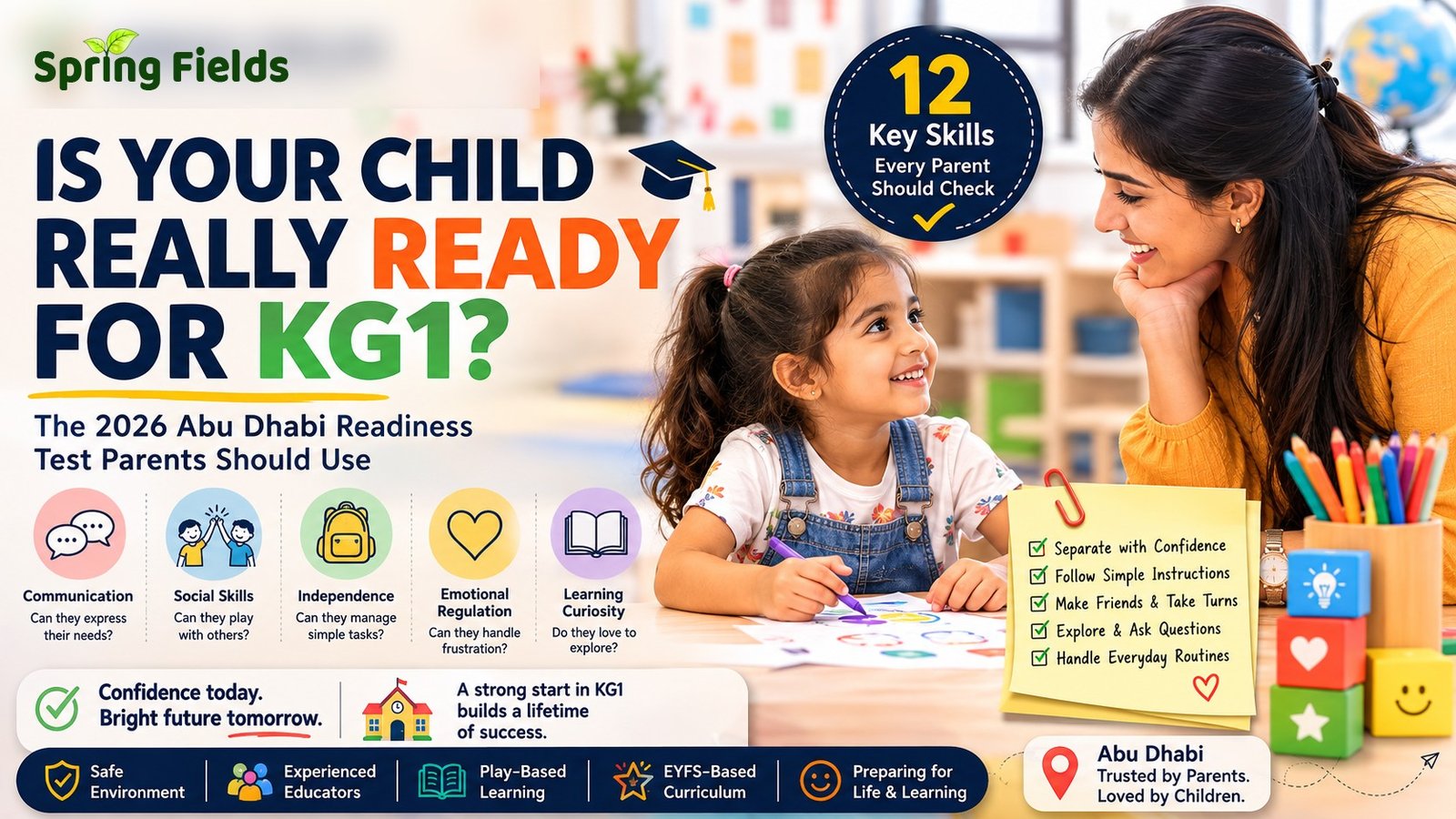
Is Your Child Really Ready for KG1? The 2026 Abu Dhabi Readiness Test Parents Should Use
Your child knows the alphabet. They can count. They can recognise colours and maybe even write their name.
So, are they ready for KG1?
Not necessarily.
KG1 readiness is about much more than academic skills.
For a child starting kindergarten in Abu Dhabi, readiness includes communication, independence, emotional regulation, social confidence, attention, physical coordination and the ability to participate in a group environment.
The good news is that your child does not need to master everything before starting KG1.
The purpose of this guide is not to give parents another test that creates anxiety. It is a practical way to understand where your child is now, what skills are developing, and how nursery and home experiences can support the transition.
What Does KG1 Readiness Actually Mean?
KG1 readiness means that a child has developed enough foundational skills to participate positively in a structured early-learning environment.
It does not mean your child needs to:
- Read independently
- Write sentences
- Count to 100
- Know every letter
- Perform formal mathematics
- Sit perfectly still
- Never become upset
- Be completely independent
Children develop at different rates.
The UAE’s official education guidance describes kindergarten as a stage where children develop social, language, physical and academic skills before progressing to primary education.
That is an important distinction.
KG1 is itself part of the learning journey.
Your goal as a parent is not to finish KG1 before your child starts it.
Your goal is to give your child enough confidence, communication and independence to begin that journey successfully.
First: Check the KG1 Age Requirement
Before assessing readiness, check whether your child meets the admission requirements for the specific school and curriculum you are considering.
The UAE Government states that KG1 admission age is generally based on the child being 4 years old by 31 August of the admission year, but the published federal guidance specifically describes eligibility categories for public-school admissions. Private schools and different curricula can have their own admission policies.
Therefore, parents in Abu Dhabi should always confirm the current admission and age requirements directly with the school before making a decision.
Age eligibility and developmental readiness are two different things.
A child can be old enough for KG1 but still need additional support with certain readiness skills.
Another child of the same age may already be very confident.
Both situations can be completely normal.
The 2026 KG1 Readiness Test
Use the following checklist as a conversation starter, not a pass-or-fail examination.
For each skill, ask yourself:
Yes – My child usually does this independently.
Developing – My child can do it sometimes or with support.
Not yet – My child is still developing this skill.
There is no requirement for every answer to be “Yes”.
1. Can Your Child Separate From You?
This is one of the most important parts of KG1 readiness.
Your child may become upset when you leave.
That is normal.
The important question is whether they can eventually settle with a trusted adult and begin participating in activities.
Look for signs such as:
- Your child can say goodbye with support.
- They can stay with another trusted adult.
- They recover after becoming upset.
- They can become interested in an activity after separation.
- They understand that you will return.
A child does not need to walk into KG1 on the first day without tears.
They need to gradually learn:
“My parent leaves, I am safe, and my parent comes back.”
This is one reason nursery experience can be valuable.
At Spring Fields, children learn within age-appropriate classes and gradually develop independence in a safe environment. The nursery currently offers classes for children from 1–2, 2–3 and 3–4 years, with classrooms designed around children’s developmental stages.
2. Can Your Child Communicate Basic Needs?
Your child does not need perfect English.
They do need a way to communicate important needs.
Can they tell an adult:
- “I need the toilet.”
- “I’m hungry.”
- “I’m thirsty.”
- “I don’t feel well.”
- “I need help.”
- “I don’t like that.”
- “I’m hurt.”
Communication is one of the most important foundations for a positive KG1 experience.
A child who cannot communicate a basic need may become frustrated, withdrawn or dependent on adults to interpret their behaviour.
At home, encourage communication by:
Instead of immediately solving a problem, give your child opportunities to explain it.
Try:
“Tell me what happened.”
“What do you need?”
“How are you feeling?”
This builds vocabulary and confidence at the same time.
3. Can Your Child Follow Simple Instructions?
KG1 involves many everyday instructions.
“Put your bag here.”
“Come and sit on the carpet.”
“Choose a book.”
“Wash your hands.”
“Put the blocks away.”
“Stand in line.”
Your child does not need to follow every instruction perfectly.
But they should be developing the ability to listen, process and respond.
Try this at home
Give your child two-step instructions:
“Put the toy in the box and bring me the book.”
If they can do this with reasonable consistency, that is a useful sign of developing readiness.
You can gradually increase the complexity.
4. Can Your Child Participate in a Group?
One of the biggest differences between home and KG1 is the presence of other children.
Your child will not have an adult available exclusively for them.
They will need to:
- Listen while other children speak
- Wait for a turn
- Join group activities
- Follow classroom routines
- Share resources
- Move between activities
- Accept that other children may have different ideas
These skills develop through experience.
They are not something you need to teach through worksheets.
Playdates, story groups, nursery sessions and family activities can all provide opportunities to practise them.
5. Can Your Child Manage Small Frustrations?
This does not mean your child should never have a tantrum.
Four-year-olds still experience big emotions.
KG1 readiness means gradually developing the ability to recover from small frustrations.
For example:
The favourite toy is being used by someone else.
The drawing doesn’t look the way they expected.
They lose a game.
A friend says “no”.
An activity ends.
Can your child eventually calm down with appropriate adult support?
That is more important than whether they become upset in the first place.
Help build this skill by teaching simple language:
“I am frustrated.”
“Can I have a turn?”
“I need help.”
“Let’s try again.”
These phrases give children alternatives to immediately crying, hitting or withdrawing.
6. Is Your Child Developing Independence?
KG1 teachers cannot perform every task for every child.
Your child will gradually be expected to manage simple parts of their day.
Depending on age and development, this might include:
- Putting belongings in the right place
- Removing or putting on simple clothing items
- Eating independently
- Washing hands
- Tidying toys
- Choosing an activity
- Carrying their own bag
- Asking for help when needed
Don’t turn independence into pressure.
Give your child opportunities to try.
A five-minute struggle with putting on shoes can sometimes teach more independence than having an adult do it perfectly in 20 seconds.
7. What About Toilet Training?
Toilet independence can be an important part of preparing for school, but parents should avoid treating accidents as a failure.
Children develop bladder and bowel control at different rates.
Before KG1, ask the school what its specific toileting expectations are.
At home, encourage your child to:
- Recognise when they need the toilet
- Tell an adult
- Follow a simple toilet routine
- Wash their hands afterwards
- Manage clothing as independently as possible
If accidents still happen occasionally, communicate openly with the school.
A supportive early-years environment should approach toileting with dignity rather than embarrassment.
SFN already has a dedicated guide on toilet training toddlers at nursery in the UAE, which can be useful for parents working on this stage.
8. Can Your Child Listen to a Short Story?
Storytime is much more than entertainment.
It develops:
- Listening
- Vocabulary
- Memory
- Imagination
- Sequencing
- Attention
- Early literacy
Try reading a short story and then asking:
“What happened first?”
“Who was in the story?”
“What happened at the end?”
Your child does not need to answer every question correctly.
What matters is their willingness to listen, understand and participate.
9. Is Your Child Developing Fine Motor Control?
Your child does not need perfect handwriting before KG1.
But they should have opportunities to strengthen their hands and fingers.
Useful activities include:
- Drawing
- Painting
- Playdough
- Building blocks
- Puzzles
- Threading
- Peg activities
- Using child-safe scissors
- Turning book pages
- Picking up small objects with appropriate supervision
These activities help develop the coordination needed later for writing and other classroom tasks.
SFN’s play-based approach includes hands-on activities designed around children’s developmental needs. Its EYFS-based learning philosophy combines structured learning with imaginative and purposeful play.
10. Can Your Child Play Independently?
This is an underrated readiness skill.
A child who can play independently for a short period is developing:
- Concentration
- Creativity
- Problem-solving
- Decision-making
- Self-confidence
Independent play does not mean leaving a child completely alone.
It means giving them a safe environment and allowing them to decide what to do.
Try setting up:
Blocks + books + drawing materials
and saying:
“You choose what you want to do.”
Then resist the urge to direct every step.
11. Can Your Child Interact With Other Children?
Your child does not need to be extremely outgoing.
Some children are naturally quiet.
The question is whether they are gradually learning how to participate socially.
Look for behaviours such as:
- Watching other children play
- Joining activities
- Taking turns
- Sharing with support
- Saying hello
- Asking another child to play
- Responding when another child speaks
- Seeking adult help when there is a conflict
Social confidence develops through repeated positive experiences.
A nursery can provide much more daily peer interaction than many children experience at home.
12. Does Your Child Show Curiosity?
This might be the most important question on the entire checklist.
Does your child:
Ask why?
Want to know how things work?
Explore new objects?
Ask questions?
Try different ways to solve a problem?
Show excitement when discovering something new?
These behaviours matter because early education is not simply about transferring information.
It is about developing a child who wants to learn.
The UAE’s broader education strategy also places importance on skills such as problem-solving, creativity, communication and collaboration.
Your KG1 Readiness Score
Now count your answers.
Mostly “Yes”
Your child appears to have a strong foundation for starting KG1.
Continue practising everyday independence and communication without turning preparation into academic pressure.
A mixture of “Yes” and “Developing”
This is completely normal.
Identify the two or three areas that need the most practice and build them naturally into daily routines.
Several “Not Yet”
Don’t panic.
A checklist is not a diagnosis.
It simply tells you where your child may need additional support or more opportunities to practise.
Talk to your child’s nursery educator or prospective school.
The right support can make a significant difference.
What Parents Should NOT Do Before KG1
Preparing for school can accidentally become a pressure-filled exercise.
Avoid turning the months before KG1 into an academic boot camp.
Your child does not need hours of worksheets every day.
Avoid:
Forcing handwriting
Fine motor development should come before handwriting perfection.
Overloading your child with worksheets
Young children learn through movement, conversation, play and exploration.
Comparing them with other children
Development is not a race.
Treating reading as a requirement
Encourage books and storytelling without turning reading into a test.
Correcting every mistake
Children need confidence to experiment.
Expecting perfect behaviour
Emotional regulation develops gradually.
What Actually Helps a Child Prepare for KG1?
The most effective preparation often looks surprisingly ordinary.
Read together every day
Even 10–15 minutes of shared reading can create valuable opportunities for language and listening.
Give your child choices
“Do you want the blue cup or the green cup?”
Simple choices build independence.
Let them help
Ask your child to:
- Put toys away
- Carry their plate
- Sort socks
- Put books on the shelf
- Help prepare simple snacks
Encourage conversation
Ask questions that require more than “yes” or “no”.
Instead of:
“Did you have fun?”
Try:
“What was the funniest thing you did today?”
Play together
Build towers.
Make pretend shops.
Cook imaginary meals.
Create stories.
Draw.
Dance.
Sing.
Play is not time away from learning.
Play is one of the ways young children learn.
Why Nursery Can Make the KG1 Transition Easier
A quality nursery gives children something that worksheets cannot provide:
Repeated experience of being part of a learning community.
They learn what it feels like to:
- Arrive somewhere without a parent
- Build relationships with teachers
- Play beside other children
- Follow routines
- Participate in group activities
- Ask for help
- Solve small problems
- Move between activities
- Take responsibility for belongings
- Experience separation and reunion
ADEK’s early-education policies include specific frameworks around child supervision, behaviour management, parent engagement and communication, highlighting the importance of a structured and supportive early-years environment.
At Spring Fields, children learn through the British EYFS framework, with play-based experiences supporting communication, independence, creativity and school readiness.
How Spring Fields Supports KG1 Preparation
At Spring Fields Preschools, school readiness is not treated as a separate subject.
It is developed through everyday experiences.
The nursery’s British EYFS-based approach focuses on children’s emotional, social, physical and intellectual development while encouraging curiosity, independence and confidence.
Children at Spring Fields are grouped according to age and developmental stage, with the F-S1 class serving children aged 3–4 years — the stage immediately relevant to many families preparing for the next step into formal schooling.
The focus is not simply:
“Can this child read?”
It is:
“Can this child communicate, participate, explore, develop independence and feel confident in a learning environment?”
That is a much more meaningful definition of school readiness.
Parents can also explore SFN’s existing guide to 8 kindergarten readiness skills in Abu Dhabi for a deeper look at individual developmental milestones.
A Simple 30-Day KG1 Preparation Plan
You don’t need a complicated programme.
Try one small focus each week.
Week 1: Independence
Let your child practise:
- Putting toys away
- Carrying their bag
- Choosing clothes
- Washing hands
- Helping with simple household tasks
Week 2: Communication
Practise:
- Naming emotions
- Asking for help
- Explaining what happened
- Talking about the day
- Telling simple stories
Week 3: Social Skills
Create opportunities for:
- Turn-taking
- Sharing
- Group play
- Simple board games
- Playdates
Week 4: Routine
Practise:
- Waking up at a consistent time
- Getting dressed
- Eating breakfast
- Leaving home calmly
- Following a predictable evening routine
By the end of the month, don’t ask:
“Is my child perfect?”
Ask:
“Is my child more confident than they were four weeks ago?”
That’s the progress that matters.
The Most Important KG1 Readiness Test
There is one question that matters more than whether your child can write their name.
Ask:
“Does my child feel safe, curious and increasingly confident when learning away from me?”
If the answer is yes, you already have an important foundation.
Academic skills will continue developing.
Vocabulary will expand.
Writing will improve.
Numbers will become more complex.
But confidence, independence, curiosity and emotional security provide the foundation on which those academic skills are built
Final Thoughts for Abu Dhabi Parents
Starting KG1 is a big transition for both children and parents.
It is natural to wonder whether your child is ready.
But readiness should never be reduced to a list of academic achievements.
A child who can recognise every letter but cannot communicate when they need help may need more support.
A child who knows fewer letters but can confidently enter a classroom, talk to an adult, join a group, solve small problems and try something new may have a very strong foundation.
That is what KG1 readiness really means.
If your child is approaching the next stage of education, use this checklist as a starting point.
Observe.
Encourage.
Practise.
Talk to educators.
And most importantly, give your child time to grow.
Frequently Asked Questions
What age should a child be for KG1 in Abu Dhabi?
The UAE Government states that KG1 is generally for children who are at least four years old by 31 August of the admission year, but parents should check the specific admission rules of the school and curriculum they are applying to.
What skills should a child have before KG1?
Important KG1 readiness skills include communication, independence, social interaction, emotional regulation, following simple instructions, attention, fine motor development and curiosity. Children do not need advanced reading or writing skills before starting KG1.
Does my child need to know the alphabet before KG1?
No. Alphabet knowledge can be helpful, but KG1 readiness is broader than academic knowledge. Language, communication, social development, independence and a positive attitude toward learning are equally important.
Should my child be fully toilet trained before KG1?
Toileting expectations vary between schools. Parents should ask their chosen school about its policy. Children develop toilet independence at different rates, and occasional accidents can occur.
How can I prepare my child for KG1 at home?
Read together, encourage conversation, practise simple routines, give your child age-appropriate responsibilities, arrange opportunities for social play and encourage independent problem-solving.
Is nursery necessary before KG1?
Nursery is not the only way to develop school-readiness skills, but a quality nursery can provide regular opportunities for children to practise communication, independence, social interaction, routines and learning alongside peers.
What if my child is not ready for KG1?
Don’t panic. Identify the areas where your child needs support and discuss them with their nursery educator or prospective school. Readiness develops over time and children progress at different rates.