

Abu Dhabi Nursery Ratios 2026: What Parents Should Know Before Choosing a Nursery
When parents search for a nursery in Abu Dhabi, they usually compare curriculum, fees, location, facilities, activities and reviews.
But there is another question that deserves much more attention in 2026:
How many children will each adult actually be responsible for?
This has become particularly important because Abu Dhabi’s Department of Education and Knowledge (ADEK) has established new minimum adult-to-child supervision ratios for Early Education Institutions, with the relevant ratios applying from 1 September 2026, subject to the policy’s stated grace period for certain low-to-mid fee classification institutions.
For parents choosing a nursery, this isn’t just a regulatory detail.
It can directly affect how much individual attention a young child receives during the day.
What Are the New Abu Dhabi Nursery Ratios?
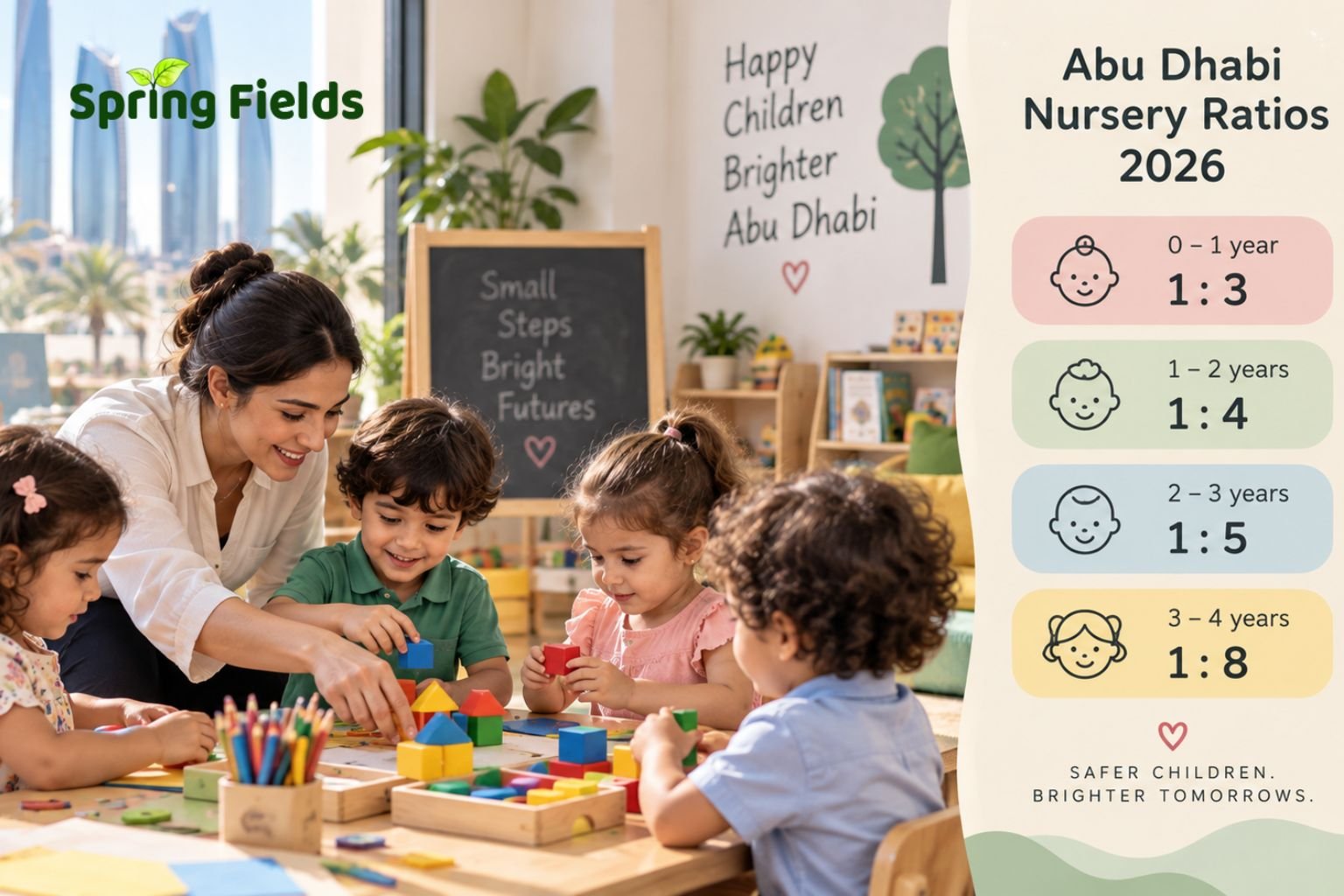
ADEK’s Child Supervision Policy sets minimum adult-to-child ratios according to age:
| Child’s age | Minimum adult-to-child ratio |
|---|---|
| 0–1 year | 1:3 |
| 1–2 years | 1:4 |
| 2–3 years | 1:5 |
| 3–4 years | 1:8 |
The policy also requires at least two staff members to be present on the premises whenever children are present.
There is an important qualification: institutions in the low-to-mid fee classification have a grace period extending to 1 September 2028 for these ratios. Parents should therefore ask their chosen nursery which compliance timeline applies to it.
What Does 1:5 Actually Mean for Your Toddler?
Imagine your two-year-old is in a classroom with four other children and one adult.
That is a 1:5 ratio.
Now think about everything that happens during an ordinary nursery morning.
A child may need help washing their hands.
Another may need support opening their lunch.
Someone might become upset.
Another child may need help with an activity.
Someone else may simply need reassurance.
Early-years education is full of these small moments.
That is why ratios matter.
They aren’t simply numbers on a policy document. They help determine the amount of adult supervision available while children are playing, learning, eating, moving around and developing independence.
Why Ratios Matter More at Younger Ages
A three-year-old may be able to communicate their needs relatively clearly.
A younger toddler may not.
A child may communicate hunger, tiredness, discomfort or frustration through behaviour rather than words.
This makes attentive adult interaction particularly important during the early years.
Spring Fields offers classes covering the 1–2, 2–3 and 3–4 age groups, with classrooms designed around children’s developmental stages.
Parents can explore the Spring Fields classes and age groups before arranging a visit.
What Parents Should Ask During a Nursery Visit
Don’t simply ask:
“What is your teacher-to-child ratio?”
Ask a few more specific questions.
1. What is the ratio in my child’s actual classroom?
A nursery may have a good overall staffing level, but what matters is the environment your child will actually spend time in.
2. Who is supervising the children?
Ask about educators, assistants and other staff members.
3. How does the nursery manage busy periods?
Mealtimes, outdoor play, bathroom routines and transitions can require additional supervision.
4. What happens when a staff member takes a break?
The required ratio needs to be maintained appropriately rather than existing only on paper.
5. Can I see the current staff roster?
ADEK’s policy requires institutions to maintain staffing information, including daily adult-to-child ratios for areas.
A transparent nursery should be comfortable explaining how its staffing works.
Ratio Is Important — But It Isn’t Everything
A low number alone doesn’t automatically mean a nursery is excellent.
Parents should also consider how educators interact with children.
Watch what happens during a nursery visit.
Do educators get down to the child’s level?
Do they listen?
Do they respond when a child needs help?
Do children appear comfortable approaching them?
Are activities appropriate for the children’s ages?
These observations can tell you something that a brochure cannot.
Spring Fields describes its approach as British EYFS-based and play-oriented, with learning experiences designed to develop communication, literacy, numeracy, physical coordination, social skills and independent thinking.
Why This Matters When Choosing a Nursery in Central Abu Dhabi
Abu Dhabi has more than 200 private nurseries, offering different curricula and approaches for children from infancy to four years old.
That means parents have plenty of choice—but also plenty to compare.
For families living or working around Al Danah, Al Falah, Najda Street and central Abu Dhabi, location can make a nursery part of the daily routine rather than a long commute.
Spring Fields Preschools is located at No. 48, Al Falah Sector, East 18/3, Najda Street, behind Burjeel Hospital, Al Danah, Zone 1, Abu Dhabi.
You can contact Spring Fields Preschools to arrange a visit and ask about current availability, classes and admissions.
The Better Question to Ask in 2026
Parents often ask:
“Which is the best nursery in Abu Dhabi?”
There isn’t one universal answer.
The better question is:
“Which nursery is the right fit for my child’s age, development and our family’s routine?”
Look at the curriculum.
Look at the educators.
Look at the environment.
Look at the daily routine.
And now, look at the adult-to-child ratio.
Because for a young child, having enough adults available isn’t a luxury.
It is part of creating a safe, responsive and supportive early-learning environment.
FAQs
What is the nursery teacher-to-child ratio in Abu Dhabi in 2026?
ADEK’s minimum adult-to-child ratios are 1:3 for children aged 0–1, 1:4 for 1–2, 1:5 for 2–3 and 1:8 for 3–4, with a stated grace period for certain low-to-mid fee classification institutions.
Why are nursery ratios important?
Ratios influence the amount of adult supervision and individual attention available during everyday activities such as play, meals, transitions and personal care.
What ratio applies to a two-year-old in Abu Dhabi?
Under ADEK’s policy, the minimum ratio for children aged 2–3 is one adult to five children (1:5).
What should I ask a nursery about its staffing?
Ask about the ratio in your child’s actual classroom, who supervises the children, how staffing works during breaks and whether you can see the current staff roster.
How do I choose a good nursery in Abu Dhabi?
Consider more than fees or facilities. Look at the curriculum, educators, classroom environment, physical activity, communication, daily routine, staffing, location and how well the nursery suits your child’s individual stage of development.