

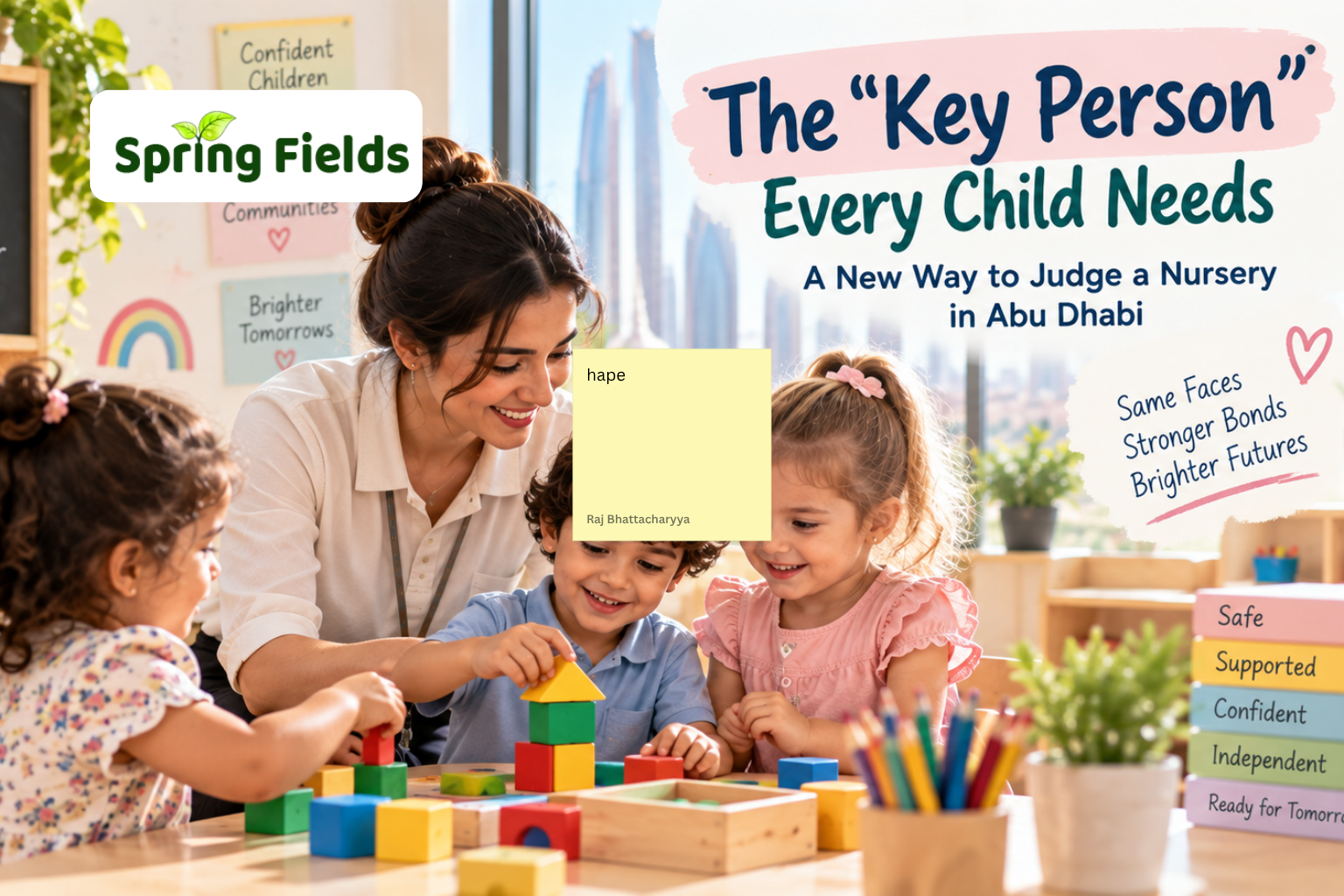
The “Key Person” Every Child Needs: A New Way to Judge a Nursery in Abu Dhabi
When parents search for a nursery in Abu Dhabi, they usually look at the things they can see immediately: classrooms, outdoor spaces, curriculum, fees, activities and reviews.
But there is something less visible that can have a major impact on a young child’s experience:
Who is the person your child will learn to trust?
In Abu Dhabi, this question has become even more relevant because ADEK’s Settling-In Policy formally recognises the Key Person approach in Early Education Institutions.
A Key Person is a staff member who acts as the primary contact for a particular group of children and helps them feel safe, cared for and secure.
For parents choosing a nursery, this is worth understanding.
Because your child doesn’t simply need a classroom.
They need relationships.
What Is a Key Person in a Nursery?
Think of a Key Person as a familiar adult who becomes an important emotional anchor for your child at nursery.
They may:
- Welcome your child in the morning
- Help them settle into the classroom
- Understand their interests and personality
- Notice changes in their behaviour
- Support them during difficult moments
- Encourage communication and independence
- Communicate important observations with parents
- Help create continuity between home and nursery
ADEK’s policy describes the wider Key Team as the educators and staff who interact with children regularly and take care of their physical, emotional and educational needs.
This is particularly valuable during the early years, when children are still developing their ability to communicate feelings and manage transitions.
Why Does This Matter So Much for Toddlers?
Imagine being two years old and entering an unfamiliar room.
There are new children.
New toys.
New sounds.
A different routine.
And your parent has just walked away.
For an adult, that might simply be a new environment.
For a toddler, it can feel enormous.
A familiar educator can provide a sense of continuity.
Over time, the child begins to recognise:
“This is the person who knows me.”
That relationship can make everyday experiences—from arriving in the morning to trying a new activity—feel more predictable.
And predictability matters during early childhood.
The Key Person Is More Than “The Teacher”
This distinction is important.
A teacher’s role is not simply to deliver activities.
Early-years educators observe children, respond to their interests, support relationships and help children become increasingly independent.
For example, a child may be fascinated by dinosaurs.
Another may love drawing.
Another may be hesitant around larger groups.
Another may prefer observing an activity before joining.
A responsive educator notices these differences.
Instead of expecting every child to learn in exactly the same way, they can use those interests and behaviours to support learning.
That fits naturally with the British EYFS approach used at Spring Fields Preschools, where learning is designed around children’s individual development through play, exploration and meaningful experiences.
What Should Parents Ask a Nursery in Abu Dhabi?
The next time you visit a nursery, don’t only ask:
“What curriculum do you follow?”
Ask:
“Who will be my child’s Key Person?”
This simple question can tell you a surprising amount.
Then ask:
“How long will my child spend with that educator?”
Consistency matters.
Also ask:
“What happens if my child becomes upset?”
You want to understand who will respond and how.
And ask:
“How will the Key Person communicate with us?”
A strong nursery-parent relationship doesn’t end at pick-up time.
ADEK’s Parent Engagement and Communication Policy requires nurseries to provide parents with information about areas including staffing, adult-to-child ratios, learning approaches and the settling-in process.
Look at the Relationship, Not Just the Classroom
During a nursery visit, watch the educators.
You don’t need to analyse everything.
Just observe.
Do children comfortably approach adults?
Do educators listen when children speak?
Do they respond calmly when a child becomes upset?
Do they get down to the child’s level?
Do they encourage children to try things independently?
Do they know individual children’s interests?
These small observations can reveal more about a nursery’s culture than an impressive brochure.
At Spring Fields, the learning environment is designed around age-appropriate resources and opportunities for children to explore and investigate independently. Its classes cover Toddler (1–2), Nursery (2–3) and F-S1 (3–4) age groups.
Why This Is Especially Important During Settling-In
Starting nursery is one of the biggest transitions in a young child’s early life.
ADEK’s Settling-In Policy recognises settling-in as the process of becoming accustomed to new people, environments and routines. Importantly, ADEK states that the settling-in period may last from one to three weeks depending on the child.
That means there shouldn’t be an expectation that every child will adapt at exactly the same speed.
One child may walk into the classroom confidently.
Another may need more reassurance.
Another may spend several days observing before becoming actively involved.
A Key Person can help make that transition more personal.
Instead of your child simply being “one of the children in the class,” there is a familiar adult who knows what helps them feel comfortable.
The Hidden Benefit: Better Communication With Parents
A Key Person can also improve something parents often struggle with:
knowing what actually happened during the day.
“Your child had a good day” is reassuring.
But imagine instead hearing:
“She spent quite a long time building with blocks today and eventually invited another child to join her.”
That tells you something meaningful.
It gives you an insight into your child’s interests, relationships and development.
Good communication can also help parents reinforce learning at home.
If an educator notices that a child is particularly interested in colours, animals or storytelling, parents can continue those conversations outside nursery.
The nursery and home then become connected rather than separate worlds.
Does Every Child Need the Same Kind of Key Person?
No.
And that’s the point.
Early childhood is not one-size-fits-all.
Some children are naturally outgoing.
Others need more time.
Some love group activities.
Others prefer quieter exploration.
Some communicate constantly.
Others express themselves through actions before words.
A good early-years environment recognises these differences.
The goal isn’t to make every child behave the same way.
It is to help each child feel safe enough to explore, confident enough to participate and supported enough to become independent.
Choosing a Nursery in Abu Dhabi: Add This Question to Your List
Parents already ask about:
- Fees
- Curriculum
- Timings
- Meals
- Outdoor play
- Safety
- Staff qualifications
- Location
Add one more:
“How does your Key Person approach work?”
It is a small question with a big implication.
Because when you’re choosing a nursery, you’re not only choosing where your child will learn.
You’re choosing some of the adults who will help shape your child’s first experiences outside home.
At Spring Fields Preschools, children learn in a nurturing environment based on the British EYFS framework, with play, exploration, communication and individual development forming important parts of the learning experience.
For families looking for a nursery in Abu Dhabi, visiting the setting and speaking directly with the educators can be one of the best ways to understand whether the environment feels right for your child.
Because sometimes the most important feature of a nursery isn’t something you can photograph.
It’s the relationship your child builds with the person waiting to welcome them through the door.
FAQs
What is a Key Person in a nursery?
A Key Person is a designated staff member who acts as a primary contact for a group of children and helps them feel safe, cared for and secure. ADEK formally defines the role in its Settling-In Policy.
Why is the Key Person approach important for toddlers?
Toddlers are still developing communication, emotional regulation and independence. Having a familiar adult can provide continuity and reassurance as they experience new people, routines and environments.
Does ADEK require a Key Person approach?
ADEK’s Settling-In Policy formally defines the Key Person and Key Team approach for Early Education Institutions and sets out how settling-in should be planned and managed.
What should I ask a nursery about its Key Person?
Ask who your child’s Key Person will be, how consistently your child will interact with them, how they support settling-in and how they communicate observations and concerns with parents.
Is the Key Person the only educator who looks after my child?
No. The Key Person is part of a wider Key Team. ADEK describes this team as the staff who regularly interact with children and support their physical, emotional and educational needs.