
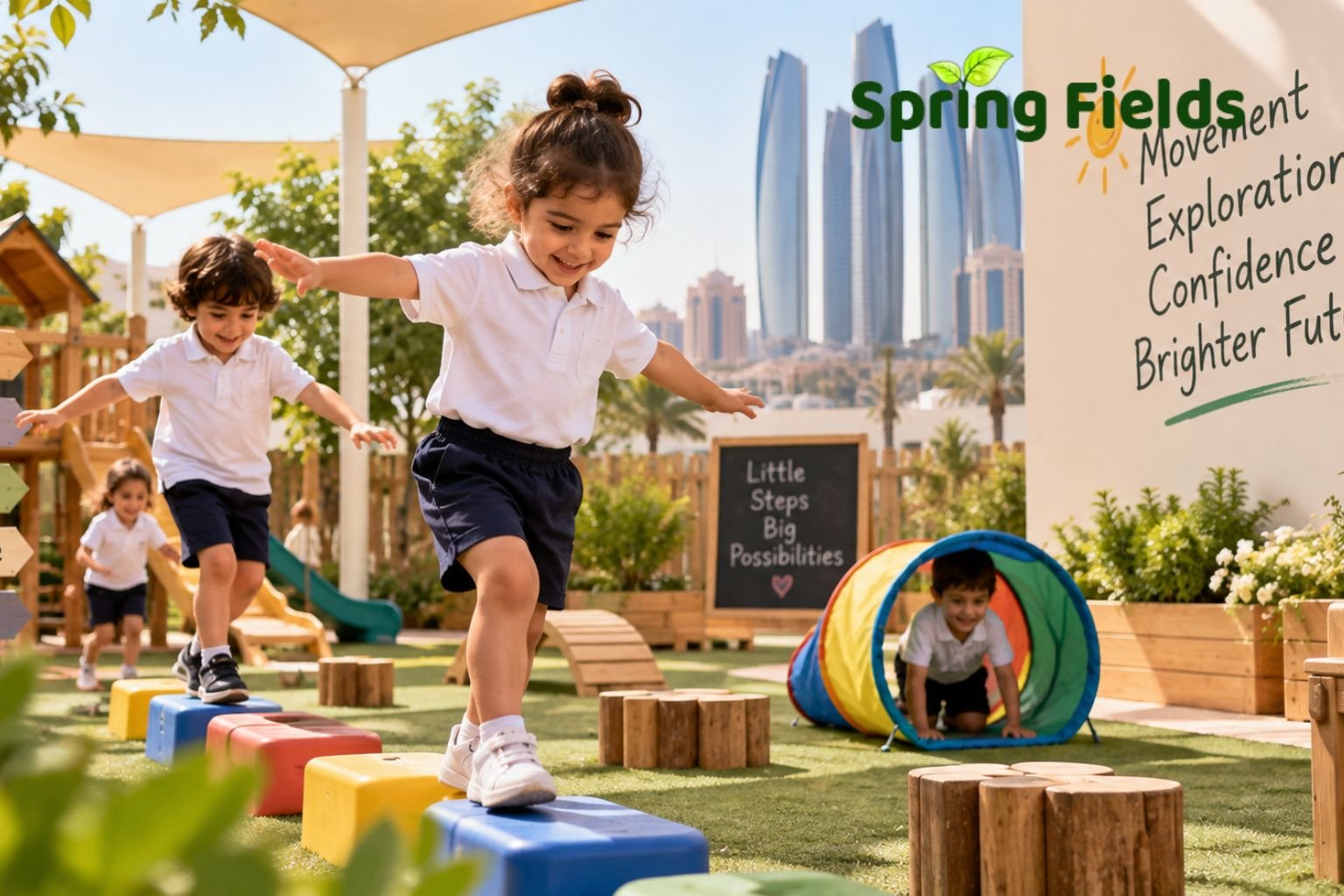
Why Movement-Rich Learning Is Becoming a Bigger Priority in Abu Dhabi Nurseries
For a toddler, learning does not always happen sitting at a table.
Sometimes it happens while climbing, balancing, carrying, jumping, dancing, crawling or simply moving from one activity to another.
That idea is becoming increasingly important in early childhood education in Abu Dhabi. ADEK’s new Physical Activity Policy took effect on 2 January 2026, with compliance beginning in the 2026/27 academic year. The policy specifically aims to promote developmentally appropriate physical activity and physical literacy for young children.
This points to a broader shift in how early learning is being understood.
For young children, movement is not a break from learning. Movement can be part of learning itself.
What Is Movement-Rich Learning?
Movement-rich learning means creating opportunities for children to use their bodies while developing other skills.
Instead of separating:
learning → physical activity → play
a movement-rich environment connects them.
A simple activity such as walking along a line can involve balance and coordination.
Building an obstacle course can involve:
- Physical coordination
- Problem-solving
- Following instructions
- Confidence
- Turn-taking
- Spatial awareness
Dancing to a song can support movement, rhythm, listening and communication at the same time.
This is particularly relevant during the early years, when children are developing rapidly across physical, cognitive, social and emotional areas.
Why Abu Dhabi Is Paying More Attention to Physical Activity
ADEK’s current early education framework recognises physical activity as an important part of children’s development. Its Physical Activity Policy is designed to ensure children receive safe, engaging and developmentally appropriate opportunities that support physical literacy and developmental milestones.
This sits within a wider Abu Dhabi focus on holistic early childhood development.
The Abu Dhabi Early Childhood Authority has also identified physical and emotional intelligence, imagination and creativity among the capabilities that should be supported as education evolves. Its future-focused research highlights a need to adapt education rather than simply adding more technology or academic content.
The message is increasingly clear:
Early education is about developing the whole child.
Movement Can Support More Than Physical Development
It is easy to think of physical activity simply as a way of helping children become stronger or more coordinated.
But movement can create learning opportunities far beyond that.
1. Balance and Coordination
Running, jumping, climbing, throwing and balancing allow young children to practise controlling their bodies.
These skills develop gradually through repeated experiences rather than through a worksheet.
2. Confidence
A child who successfully climbs over an obstacle or learns a new movement experiences something important:
“I can do this.”
That sense of capability can support confidence and independence.
3. Social Skills
Movement activities can also become social experiences.
Children learn to:
- Wait for their turn
- Follow simple rules
- Move safely around others
- Encourage friends
- Cooperate
- Communicate
These are valuable early-years skills in their own right.
4. Problem-Solving
Imagine giving a child a few soft blocks and asking:
“How can we get from here to there without touching the floor?”
There is no single answer.
The child has to experiment.
That is learning through movement.
What Does Movement-Rich Learning Look Like in a Nursery?
It does not necessarily require expensive equipment.
A quality early-years environment can incorporate movement into everyday experiences.
For example:
| Activity | What children can practise |
|---|---|
| Obstacle courses | Balance, coordination, problem-solving |
| Music and dancing | Rhythm, listening, expression |
| Ball games | Coordination, turn-taking |
| Outdoor exploration | Confidence, curiosity, physical awareness |
| Carrying and sorting objects | Strength, coordination, independence |
| Action stories | Listening, imagination, movement |
| Building activities | Fine and gross motor skills |
| Simple yoga or stretching | Body awareness and calmness |
The important factor is not how impressive the activity looks.
It is what the child is experiencing while doing it.
The Connection Between Movement and Play
This is one reason play-based learning remains so valuable.
Children rarely think:
“I am now developing my gross motor skills.”
They simply think:
“Let’s do it again!”
That natural motivation matters.
At Spring Fields Preschools, learning is built around a British EYFS-based, play-oriented approach that supports children’s physical, social, emotional and intellectual development. The nursery describes learning experiences involving hands-on activities, outdoor play, creativity, communication and exploration.
You can also explore the different Spring Fields nursery classes to see how learning is structured for different age groups.
Movement Doesn’t Mean Constant Running
A movement-rich nursery is not necessarily one where children are running around all day.
Young children also need quieter physical experiences.
For example:
- Building with blocks
- Threading objects
- Drawing
- Manipulating playdough
- Turning pages
- Pouring water
- Using tools safely
- Puzzles and construction
These activities develop fine motor control, concentration and hand-eye coordination.
So the goal isn’t simply:
“More exercise.”
It is:
“More opportunities for children to use their bodies meaningfully.”
What Parents Should Look for in a Nursery
If physical development is important to you, don’t simply ask:
“Does the nursery have outdoor play?”
Ask more specific questions.
How much movement happens during a normal day?
A nursery may have an outdoor area but still provide limited meaningful physical activity.
Are activities appropriate for different developmental stages?
A one-year-old and a three-year-old will obviously have different physical capabilities.
Do educators encourage children to move independently?
Children benefit when they can explore rather than simply being directed from one activity to another.
Is movement connected to learning?
The best experiences often combine physical activity with language, creativity, problem-solving and social interaction.
Is there a balance between active and calm periods?
Children need both.
A well-designed early-years routine should provide opportunities to move, explore, concentrate, rest and reconnect.
How Spring Fields Approaches Physical Development
At Spring Fields, the learning philosophy combines structured experiences with imaginative and purposeful play. The nursery highlights physical development alongside communication, creativity, independence and social development within its EYFS-based approach.
Its classrooms are also designed with age-appropriate resources and areas where children can explore and investigate independently.
That matters because physical development should not exist as a separate “activity” that happens once a day.
It can be part of the child’s entire experience.
A child picking up a toy.
Walking to another learning area.
Building a tower.
Dancing to a song.
Playing outside.
Climbing.
Painting.
Cleaning up.
Putting something away independently.
All of these can involve movement and development.
A More Active Definition of Early Learning
As Abu Dhabi’s early-years sector continues to evolve, the conversation is moving beyond the question of whether children are learning their numbers and letters.
Parents are increasingly asking a broader question:
Is my child developing the physical, social, emotional and cognitive foundations they need for the future?
ADEK currently lists more than 200 private nurseries across Abu Dhabi, with different curricula and approaches available to families.
That makes understanding a nursery’s actual learning environment more important than simply comparing activity lists.
A child doesn’t need every minute of the day filled with structured tasks.
They need opportunities to move, explore, communicate, experiment, play and become increasingly independent.
And sometimes, the most meaningful lesson begins when a child simply gets up and tries.
FAQs
What is movement-rich learning?
Movement-rich learning incorporates physical movement into everyday early-years experiences rather than treating exercise as a completely separate activity.
Why is physical activity important for toddlers?
Physical activity supports children’s developing coordination, balance, physical confidence and movement skills while also creating opportunities for social interaction and problem-solving.
Is movement part of early childhood education in Abu Dhabi?
Yes. ADEK’s Physical Activity Policy is specifically designed to promote safe, engaging and developmentally appropriate physical activity in early education settings.
Does movement-rich learning replace academic learning?
No. Movement can complement language, literacy, numeracy, creativity, social development and other early learning experiences.
What should parents look for in a nursery in Abu Dhabi?
Look beyond the number of activities offered. Consider the quality of play, physical opportunities, educator interaction, outdoor experiences, independence, communication and the overall learning environment.