

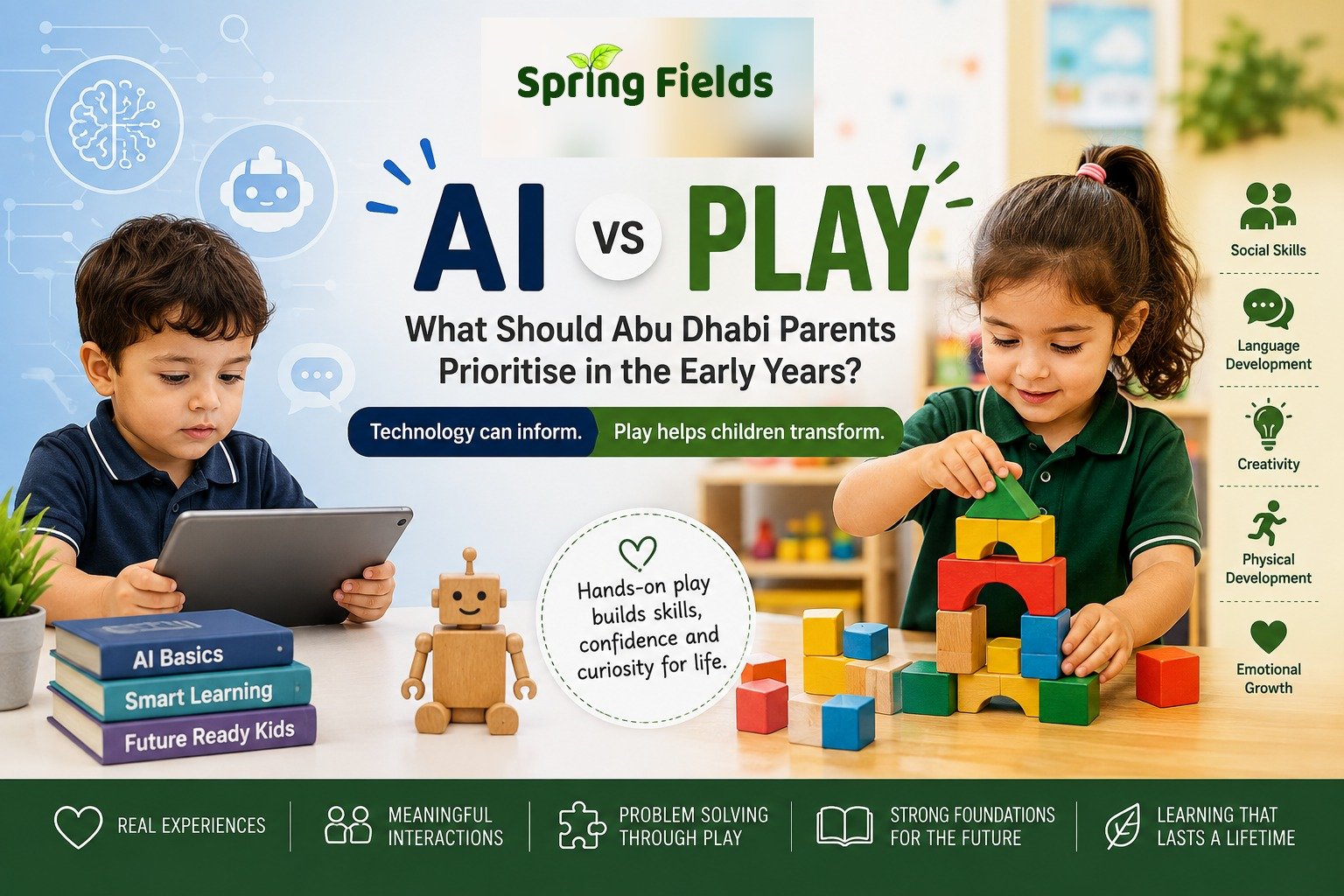
AI vs Play: What Should Abu Dhabi Parents Prioritise in the Early Years?
Artificial intelligence is changing how children learn, work and interact with technology.
AI-powered tools can now answer questions, generate stories, create pictures and provide personalised learning experiences in seconds. As these technologies become more common, parents naturally wonder what role they should play in early childhood education.
But there is an important question that deserves more attention:
Should toddlers and preschoolers be spending more time with AI, or more time playing?
For the early years, the answer is not really AI versus play.
It is about understanding what young children actually need at each stage of development.
For a three-year-old building a tower, pretending to run a shop, listening to a story or negotiating with another child over a toy, learning is already happening.
The National Association for the Education of Young Children (NAEYC) describes play as a central teaching practice that supports children’s language, social, cognitive, physical and emotional development. It also emphasises that young children need sustained opportunities for play both indoors and outdoors.
So while AI will undoubtedly become part of children’s futures, play should remain at the heart of the early years.
Why Are Parents Asking About AI in Early Childhood?
AI has moved from being something associated with technology companies to something families encounter in everyday life.
Parents may already be using AI to:
- Find educational activities
- Create children’s stories
- Generate colouring ideas
- Translate words
- Find answers to children’s questions
- Plan family activities
- Support older children’s homework
This naturally creates curiosity about whether AI can also become a learning tool for preschoolers.
There is nothing inherently wrong with introducing children to technology in an age-appropriate way.
The problem comes when technology starts replacing experiences that are fundamental to early development.
A child doesn’t need an AI system to teach them how to take turns.
They need another child.
They don’t need an algorithm to teach them empathy.
They need relationships.
They don’t need an AI-generated playground.
They need to run, climb, build, explore and interact with the physical world.
What Does Play Actually Teach Young Children?
One reason play is sometimes underestimated is that it doesn’t always look like traditional “learning”.
A child playing with blocks may appear to be simply having fun.
But consider what is happening.
They may be:
- Comparing sizes
- Counting objects
- Testing balance
- Solving problems
- Developing spatial awareness
- Using language
- Negotiating with another child
- Practising fine motor control
- Learning from failure
- Trying again
NAEYC notes that play supports language, problem-solving, social skills, self-regulation, creativity and cognitive development.
That means a play-based classroom isn’t a classroom where children are “doing nothing”.
It is a learning environment where children are actively constructing knowledge through experiences.
AI Can Provide Information. Play Provides Experience.
This is perhaps the simplest way to understand the difference.
AI can tell a child what a butterfly is.
But observing a real butterfly is different.
AI can generate a picture of a supermarket.
Pretend play allows children to become the shopkeeper, customer and cashier.
AI can describe how a tower works.
Blocks allow a child to build one, watch it fall and figure out why.
AI can generate a story.
A child acting out that story with friends adds communication, movement, negotiation and imagination.
The difference is active experience.
Young children learn by interacting with people, objects and environments.
They need opportunities to make choices, test ideas and discover consequences.
NAEYC’s research-informed guidance describes effective playful learning as active, engaging, meaningful, socially interactive and iterative.
AI vs Play: Which Skills Does Each Support?
It is useful to avoid treating the two as direct competitors.
Technology can have educational applications.
Play, however, covers an exceptionally broad range of developmental needs.
| Skill | Play | AI/Technology |
|---|---|---|
| Imagination | Excellent | Can provide prompts |
| Social interaction | Excellent | Limited |
| Turn-taking | Excellent | Limited |
| Physical development | Excellent | Very limited |
| Problem-solving | Excellent | Can support |
| Language | Strong | Can support |
| Creativity | Strong | Can provide inspiration |
| Emotional regulation | Strong | Cannot replace relationships |
| Real-world exploration | Excellent | Limited |
| Personalised information | Limited | Strong |
| Human connection | Essential | Cannot replace it |
The point isn’t that AI has no value.
The point is that AI cannot replicate the full developmental experience of play.
Why Social Play Matters
One of the biggest advantages of play is that children often play with other people.
Imagine two preschoolers building a railway.
One child wants the red train.
The other child wants it.
They have to communicate.
Maybe they argue.
Maybe an educator helps them find a solution.
Perhaps they decide to take turns.
That small interaction can involve:
- Language
- Negotiation
- Emotional regulation
- Perspective-taking
- Cooperation
- Problem-solving
These are foundational social skills.
NAEYC describes play as supporting peer relationships, communication, emotional development and self-regulation.
An AI system can simulate conversation.
It cannot replace the developmental value of real relationships with children and responsive adults.
Imagination Needs Space
Children don’t always need more information.
Sometimes they need fewer instructions.
Give a child a cardboard box and they might see:
- A car
- A house
- A rocket
- A shop
- A boat
- A castle
The object has not changed.
The child’s imagination has.
This is one of the reasons open-ended play is so valuable.
The child decides what the object becomes.
That creates opportunities for symbolic thinking, creativity and storytelling.
NAEYC identifies imaginative and symbolic thinking as important outcomes of play and highlights children’s choice, wonder and delight as important characteristics of playful learning.
What About AI-Powered Educational Apps?
Some technology can be useful.
An interactive educational application might help reinforce:
- Vocabulary
- Phonics
- Numbers
- Shapes
- Matching
- Memory
- Basic concepts
The problem is not necessarily the existence of the technology.
The question is what it replaces.
If an app replaces ten minutes of an unnecessary worksheet, the impact may be very different from an app replacing outdoor play, storytelling or interaction with other children.
Parents should therefore ask:
“What is this technology adding to my child’s experience?”
rather than:
“Is this technology educational?”
Something can be educational and still not be the most valuable activity for a particular child at a particular moment.
AI Should Support Educators — Not Replace Them
The most interesting role for AI in early childhood may actually be behind the scenes.
Educators could potentially use technology to:
- Prepare activity ideas
- Adapt resources
- Generate story prompts
- Organise information
- Support planning
- Create differentiated materials
- Save administrative time
That could allow teachers to spend more time doing what matters most:
interacting with children.
The technology should ideally make human interaction more effective rather than reduce it.
For young children, the educator remains essential.
A teacher notices that a child is frustrated.
A teacher sees that two children are struggling to cooperate.
A teacher knows when to ask a question.
A teacher can change an activity based on children’s interests.
That human responsiveness is difficult to replicate through a digital tool.
What Does “Play-Based Learning” Actually Mean?
Play-based learning doesn’t mean children simply do whatever they want all day without purpose.
There is an important distinction between free play and guided play.
In free play, children have significant control over what they do.
In guided play, educators create an environment and introduce learning goals while still allowing children to make choices and explore.
NAEYC describes guided play as an approach in which educators create the conditions for learning while children retain agency in the activity. Research discussed by NAEYC has found benefits for areas including vocabulary, spatial skills, literacy and mathematics.
For example, instead of giving children a worksheet about shapes, an educator might provide blocks and ask:
“Can you build a house with a triangle roof?”
The child is still playing.
But the educator has introduced a learning opportunity.
That is purposeful play.
What Should Abu Dhabi Parents Look for in a Nursery?
If you’re choosing a nursery in Abu Dhabi, don’t simply ask whether it uses technology.
Ask what percentage of your child’s experience involves active learning, interaction and play.
During a nursery visit, look for:
Hands-on activities
Are children touching, building, creating and experimenting?
Outdoor opportunities
Do children have regular opportunities for movement and exploration?
Social interaction
Do children spend meaningful time playing with peers?
Storytelling
Are educators talking, reading and asking questions?
Open-ended resources
Are children encouraged to use materials in different ways?
Educator interaction
Do teachers actively engage with children rather than simply supervise them?
Balanced technology
If technology is used, does it have a clear developmental purpose?
These questions can tell you much more than whether a nursery has tablets or smart screens.
The Abu Dhabi Context Matters
Abu Dhabi’s early education sector is developing rapidly, with hundreds of licensed nurseries serving families across the emirate.
ADEK’s current early education framework covers areas including learning and development, physical activity, parent engagement, health and safety, observations and assessment.
That broader approach matters.
Early childhood education isn’t just about academic preparation.
Children need opportunities to develop across multiple domains.
And technology should fit into that wider developmental picture.
For a child in Abu Dhabi growing up in a highly international environment, communication, collaboration, creativity and adaptability are likely to remain valuable skills.
Those skills don’t develop through technology alone.
They develop through relationships and experiences.
7 Things Parents Can Do at Home Instead of Reaching for a Screen
You don’t need expensive educational toys.
Try these simple activities.
1. Build something
Use blocks, cardboard or household objects.
Ask:
“What can we build?”
Don’t give them the answer.
2. Pretend to run a shop
Give your child some safe household objects and let them become the shopkeeper.
This naturally introduces counting, language and social interaction.
3. Tell a story together
Start with:
“Once there was a little girl who found a mysterious box…”
Let your child decide what happens next.
4. Cook together
Talk about ingredients, quantities, colours and textures.
5. Go outside
Look for leaves, insects, shapes and sounds.
Outdoor exploration provides experiences that a screen cannot reproduce.
6. Play board or matching games
These encourage turn-taking, memory and problem-solving.
7. Let your child get bored
Boredom isn’t always a problem.
Sometimes it creates the space for children to invent their own activities.
How Spring Fields Approaches Early Learning
At Spring Fields Preschools in Abu Dhabi, the learning approach is based around the British EYFS framework and emphasises children’s communication, creativity, independence, physical development and social development.
The nursery describes its approach as combining learning with exploration and purposeful play rather than relying solely on formal instruction. (Spring Fields Preschools)
That philosophy is particularly relevant to the AI-versus-play conversation.
The question isn’t whether children should know about technology.
They eventually will.
The question is whether the early years should be dominated by technology when children are still developing the fundamental skills that allow them to communicate, cooperate, explore and understand their physical world.
For parents considering nursery options, you can explore Spring Fields’ age-based nursery classes and learn more about its early-years approach.
AI Will Be Part of Their Future. That Doesn’t Mean It Needs to Dominate Their Childhood.
Children growing up today will probably interact with AI in ways we cannot fully predict.
They may use AI in education.
They may work alongside AI.
They may use it for creativity, research and communication.
That makes technology literacy important.
But there is a difference between preparing children for a technological future and giving young children more technology simply because it exists.
A preschooler doesn’t need to rush into the future.
They need a strong foundation.
That foundation includes:
- Communication
- Curiosity
- Creativity
- Confidence
- Relationships
- Physical development
- Emotional regulation
- Problem-solving
- Independence
And play provides opportunities to develop all of them.
So, AI or Play?
The answer is:
Play first. Technology with purpose.
AI can become a useful tool as children grow.
But during the early years, children need real people, real objects, real movement and real experiences.
They need to build.
They need to talk.
They need to imagine.
They need to make mistakes.
They need to negotiate.
They need to get messy.
They need to try again.
And they need adults who can listen, respond and guide them.
The goal isn’t to keep children away from technology forever.
It is to make sure technology doesn’t crowd out the experiences that childhood requires.
AI can provide answers.
Play teaches children how to discover them.
Frequently Asked Questions
Is AI good for preschool children?
AI can have educational uses, but its value depends on how and why it is used. For young children, technology should not replace hands-on play, physical activity, social interaction, storytelling or relationships with educators and family members.
Is play more important than technology in early childhood?
Play is a central part of developmentally appropriate early education. NAEYC identifies play as essential for children’s cognitive, language, physical, social and emotional development.
Should nurseries in Abu Dhabi use AI?
There is no need for a nursery to use AI simply because it is a current technology trend. Parents should ask whether technology has a clear educational purpose and whether it complements rather than replaces hands-on learning and human interaction.
Does play really help children learn?
Yes. Research-informed early childhood guidance links play with language, problem-solving, social skills, self-regulation, creativity and physical development.
What is guided play?
Guided play combines children’s choice and exploration with intentional learning goals introduced by an educator. It sits between completely child-directed play and direct instruction.
How much technology should a preschool child use?
There isn’t one universal amount that makes every technology experience appropriate or inappropriate. Parents should consider the child’s age, the purpose of the activity and what the technology is replacing. For young children, active play, physical activity, social interaction and real-world exploration should remain important parts of the day.
How can parents encourage learning without technology?
Read together, play pretend games, build with blocks, draw, cook, explore outdoors, sing songs, tell stories and give children opportunities to solve everyday problems independently.
What should I ask an Abu Dhabi nursery about technology?
Ask what technology is used, why it is used, how often children use it, whether educators are present during digital activities and whether screen-based activities replace play, outdoor time or social interaction.