
Bilingual Child Nursery Abu Dhabi: Arabic + English From the Start
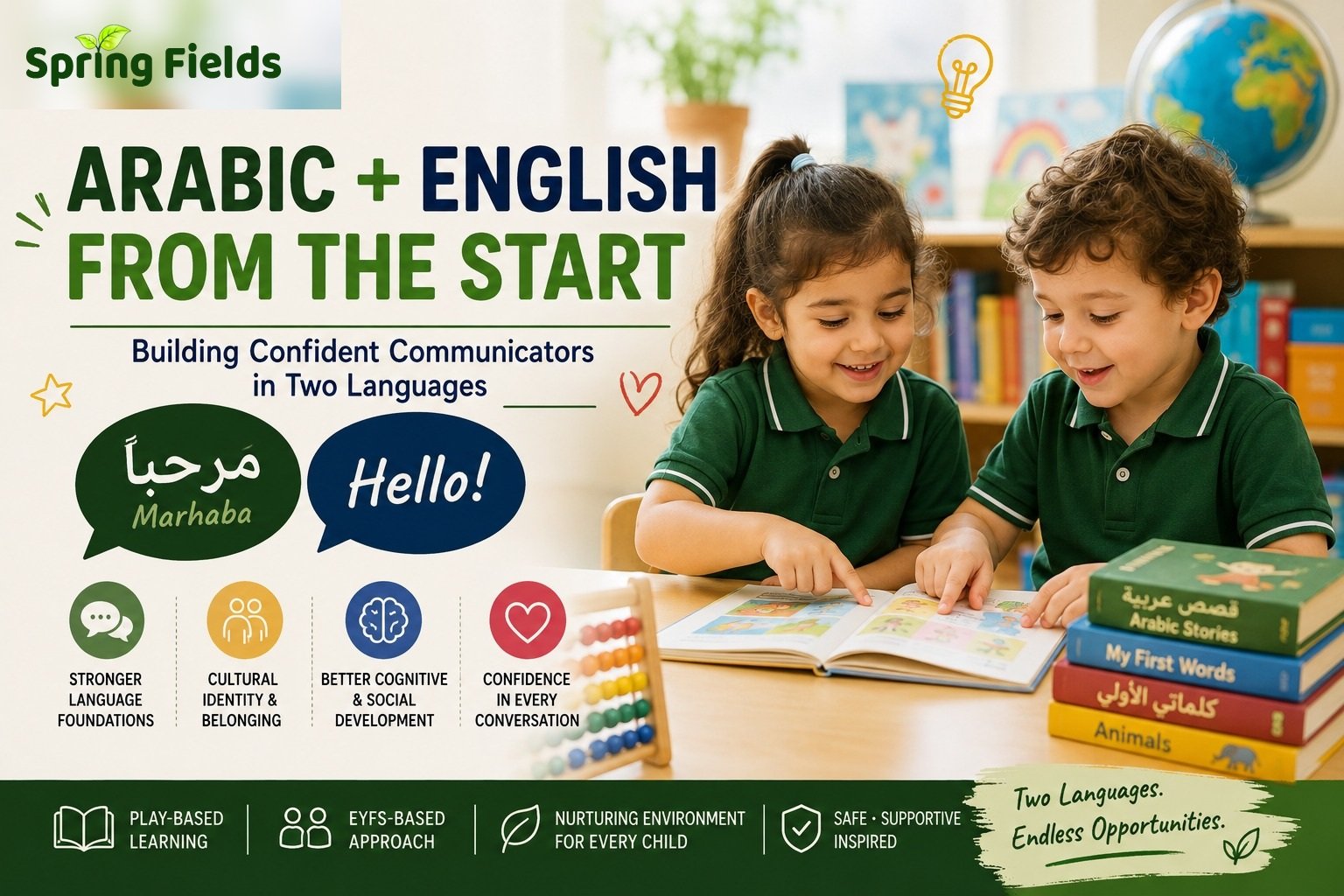
Choosing a bilingual child nursery in Abu Dhabi can be an important decision for parents who want their children to experience both Arabic and English during the early years. In Abu Dhabi’s multicultural environment, children may hear different languages at home, nursery and within their wider family and community.
A bilingual child nursery Abu Dhabi programme can give young children meaningful opportunities to listen, communicate, play and learn in more than one language. But bilingual learning is not simply about teaching children two sets of vocabulary. It can also support communication, family connections, cultural awareness and confidence.
But it also raises an important question for parents:
Should young children learn Arabic and English at the same time, or should they become confident in one language before introducing another?
The short answer is that young children can develop more than one language when they receive consistent, meaningful exposure and support.
The bigger question is how those languages are introduced.
And in Abu Dhabi, the conversation around Arabic-English early learning has become even more relevant. In October 2025, the Abu Dhabi Department of Education and Knowledge (ADEK) introduced Al Saff Al Emirati, an Arabic-led provision available to private nurseries, designed around Emirati heritage, values and the Arabic language. ADEK said 11 private nurseries had adopted the programme at the time, with further expansion expected.
For parents, this represents an important shift: bilingual early learning is not simply about teaching children two sets of vocabulary.
It can also be about identity, communication, family connection and belonging.
What Does Bilingual Early Learning Actually Mean?
A bilingual child is not necessarily a child who speaks two languages equally well.
One language may be stronger for conversation.
Another may be stronger for understanding.
A child may use Arabic for family conversations and English for nursery activities.
They may know a particular word in English but not Arabic, or vice versa.
This is normal.
Young children build language through the situations in which they use it.
For example, a child might learn:
- Arabic words for family members at home
- English words for classroom objects at nursery
- Arabic songs from grandparents
- English vocabulary through books
- Both languages through conversations with parents
- Cultural expressions through stories and celebrations
The goal should not be to make every language experience perfectly equal.
The goal is to create meaningful opportunities to understand and communicate in both languages.
The National Association for the Education of Young Children (NAEYC) notes that young children can learn two languages naturally and that a strong home-language foundation can support English acquisition.
That is particularly relevant in Abu Dhabi, where children can grow up surrounded by several languages and cultures.
Why Arabic Matters in Abu Dhabi’s Early Years
English is widely used in international education and professional environments across the UAE.
That makes English exposure valuable for many families.
But that does not mean Arabic should become secondary.
For Emirati families, Arabic can be deeply connected to:
- Family
- Heritage
- Culture
- Identity
- Community
- Stories
- Traditions
For non-Emirati families living in Abu Dhabi, Arabic can also help children develop a stronger connection with the society and culture around them.
ADEK’s Al Saff Al Emirati initiative specifically aims to strengthen Arabic literacy and national identity through an Arabic-led early-learning environment. The programme is designed for children aged 2–4 and incorporates storytelling, heritage activities, proverbs, poetry and cultural expressions into daily learning.
This is an important distinction.
Arabic does not have to be treated as a separate “subject” that children memorise.
It can become part of everyday experiences.
Can Toddlers Learn Arabic and English at the Same Time?
Yes.
Children are capable of developing multiple languages during the early years.
However, parents sometimes expect bilingual children to develop both languages at exactly the same speed.
That is not how bilingual development normally works.
Imagine a child who hears:
Arabic: primarily at home
English: primarily at nursery
That child may have a larger Arabic vocabulary for family-related conversations and a larger English vocabulary for classroom activities.
For example, they may know the Arabic words for:
- Mother
- Father
- Grandmother
- Food
- Home
- Family
while knowing more English words related to:
- Paint
- Blocks
- Book
- Circle
- Teacher
- Playground
Their combined vocabulary across both languages can therefore be much broader than what a parent sees when looking at only one language.
This is why bilingual development should be viewed across the child’s entire linguistic environment, rather than judged by comparing one language with a monolingual child.
Does Learning Two Languages Confuse a Child?
This is one of the most common concerns parents have.
A child might say:
“Mama, I want the blue car.”
and then insert an Arabic word into the same sentence.
Parents may wonder whether this means the child is confused.
Not necessarily.
Children who use more than one language may move between languages depending on the person they are speaking to, the subject they are discussing or the words that come most naturally.
This is often called code-switching.
It is not automatically a sign of poor language development.
In fact, switching between languages can be a normal part of multilingual communication.
The more useful question is:
Can the child communicate effectively and continue developing vocabulary and understanding?
If you have concerns about your child’s speech or language development, discuss them with your child’s educator or an appropriate qualified professional rather than assuming that bilingualism is the cause.
The Home Language Should Not Disappear
One of the biggest mistakes parents can make is abandoning their strongest home language because they believe English will become easier if they use it exclusively.
For many families, this can create an unintended problem.
A child may become increasingly comfortable in English while losing opportunities to communicate deeply with parents, grandparents or relatives who primarily speak Arabic or another home language.
NAEYC recommends that families continue using their home languages while children are learning English. It notes that maintaining a strong first language can support English acquisition and preserve communication between children and their families.
So if Arabic is the language you naturally speak at home, keep speaking Arabic.
Don’t feel that you have to turn your home into an English classroom.
Your child needs meaningful language, not forced language.
Arabic at Home, English at Nursery: Can That Work?
Absolutely.
In fact, a consistent division of language contexts can be helpful for some families.
For example:
At home: Arabic conversations, Arabic books and family storytelling.
At nursery: English conversations, English stories, songs and classroom activities.
The child gradually learns that both languages have a place in their life.
Another family may use both languages naturally throughout the day.
There is no single formula that works for every household.
The important factors are:
- Consistency
- Meaningful interaction
- Repetition
- Rich vocabulary
- Responsive adults
- Opportunities to speak
- Opportunities to listen
- Positive attitudes toward both languages
NAEYC’s guidance for early childhood educators similarly recommends supporting children’s home languages while they develop English, rather than treating the home language as a barrier.
Why Stories Are One of the Best Bilingual Learning Tools
You don’t need expensive language-learning technology to support Arabic and English.
A good story can do a lot.
Read the same story in both languages.
You could read an Arabic version at bedtime and an English version the following day.
Or tell a familiar story in Arabic and discuss the characters in English.
Stories naturally introduce:
- Vocabulary
- Sentence structures
- Emotions
- Sequencing
- Memory
- Imagination
- Listening
- Conversation
For younger children, repetition is particularly valuable.
A toddler may ask for the same story twenty times.
That is not wasted time.
Every repetition provides another opportunity to hear familiar words in context.
Songs Make Language Learning Natural
Songs are particularly effective for young children because they combine:
Language + rhythm + repetition + movement.
Try simple songs in both Arabic and English.
You can sing while:
- Washing hands
- Tidying toys
- Getting dressed
- Travelling
- Cooking
- Playing
- Preparing for bed
The child doesn’t need to sit down and “study” the language.
They experience it as part of everyday life.
This is exactly the kind of natural interaction that makes early bilingual development meaningful.
Play Can Build Two Languages at Once
Play is another powerful bilingual learning environment.
Imagine a pretend supermarket.
In Arabic, you might ask:
“What do you want to buy?”
Then introduce the English equivalent:
“What would you like?”
The child can hear both languages while performing the same meaningful action.
Other examples include:
Building blocks
Name shapes, colours and positions.
Cooking pretend food
Name ingredients and actions.
Dolls
Talk about emotions, family and routines.
Cars
Use words describing movement and direction.
Drawing
Talk about colours, objects and people.
The advantage of play is that the child already has a reason to communicate.
They are not learning words in isolation.
They are using language to do something.
What About Nursery-Based Bilingual Learning?
A good nursery can provide something that home cannot always replicate:
regular interaction with other children and educators in a structured environment.
Children hear language being used naturally during:
- Group discussions
- Storytime
- Songs
- Play
- Art
- Outdoor activities
- Mealtimes
- Transitions
- Everyday conversations
Abu Dhabi’s early-years environment is also becoming increasingly intentional about supporting Arabic language and cultural identity.
ADEK’s Al Saff Al Emirati programme provides an Arabic-led learning environment with Emirati educators and integrates cultural elements into children’s everyday learning.
For parents choosing a nursery, this means it is worth asking a more detailed question than:
“Do you teach Arabic?”
Ask:
“How is Arabic used throughout the child’s daily experience?”
There is a significant difference between a short vocabulary lesson and a language-rich environment.
What Should Parents Ask an Abu Dhabi Nursery?
If bilingual development matters to your family, ask these questions during a nursery visit.
1. Which languages do educators use?
Find out when and how each language is used.
2. Is Arabic part of everyday learning?
Ask whether Arabic appears in stories, songs, conversations and activities.
3. How are home languages supported?
This is especially important for families speaking Arabic or another language at home.
4. Are children encouraged to communicate in their strongest language?
A supportive environment should not make children feel embarrassed about their home language.
5. How do teachers monitor language development?
Ask how educators observe vocabulary, communication and participation.
6. How do you communicate language progress to parents?
You should know what your child is developing and where they may need additional support.
Bilingualism Is About More Than Vocabulary
There is another reason Arabic-English learning matters.
Language carries culture.
Consider what a child learns through a traditional story.
They aren’t only learning words.
They may also learn:
- Family relationships
- Respect
- Values
- History
- Traditions
- Humour
- Expressions
- Community identity
ADEK’s Al Saff Al Emirati initiative explicitly connects Arabic language development with Emirati heritage, values and national identity.
This is why bilingual education should not be reduced to a race to see how many words a child knows.
Language is also a way of understanding who we are and where we belong.
How Parents Can Support Arabic and English at Home
You don’t need a complicated programme.
Try these simple habits.
Speak naturally
Use the language you are most comfortable speaking.
Children benefit from rich, natural conversation.
Read every day
Alternate Arabic and English books or read the same story in both languages.
Sing
Songs make repetition enjoyable.
Describe everyday activities
Talk while you’re cooking, shopping, bathing or travelling.
Ask open questions
Instead of:
“Is this a red car?”
Try:
“What colour is the car?”
Then:
“Where is it going?”
Let your child answer in their strongest language
Don’t immediately correct them if they mix languages.
Respond naturally and model the language you want them to hear.
Involve grandparents
Grandparents can be an important source of rich Arabic conversation and cultural knowledge.
What If My Child Prefers English?
This can happen.
A child may begin preferring English because they spend significant time in an English-speaking nursery or school environment.
Don’t interpret this as rejection of Arabic.
Instead, continue providing meaningful reasons to use Arabic.
Try:
- Arabic storytime
- Family conversations
- Arabic songs
- Visits with Arabic-speaking relatives
- Cultural activities
- Cooking traditional food
- Arabic storytelling
- Conversations about family history
The goal isn’t to force your child to speak Arabic on demand.
It is to make Arabic useful, enjoyable and emotionally meaningful.
What If My Child Understands Arabic but Doesn’t Speak It?
This is also worth understanding.
A child may understand considerably more Arabic than they actively use.
This is sometimes described as a difference between receptive language and expressive language.
They may understand what a parent says but respond in English.
Instead of immediately saying:
“Speak Arabic.”
try continuing the conversation.
If the child answers in English, you can respond naturally in Arabic.
Over time, repeated exposure can help strengthen active use.
The same principle applies in reverse for English.
Don’t Turn Bilingual Learning Into a Test
Avoid constantly asking:
“What is this in Arabic?”
“What is this in English?”
“Say it in Arabic.”
“What does this mean?”
A few questions are fine.
But if every interaction becomes a test, language can become associated with pressure.
Children learn language best when they have a reason to communicate.
Instead of testing vocabulary, create situations where vocabulary is useful.
For example:
“We’re making a fruit salad. Which fruit should we put in next?”
That one conversation can generate more meaningful language than a vocabulary worksheet.
How Spring Fields Supports Language and Communication
At Spring Fields Preschools in Abu Dhabi, language development is part of a broader early-years approach rather than being isolated from other areas of development.
The nursery describes its British EYFS-based programme as supporting communication, language, literacy, social development, creativity, physical development and independent thinking through purposeful play.
Spring Fields has age-based classes for children from approximately 1–2, 2–3 and 3–4 years, allowing learning experiences to be adapted to children’s developmental stages.
For a bilingual or multilingual child, that kind of environment matters because language is happening throughout the day.
A child can develop communication through:
- Stories
- Songs
- Conversations
- Group activities
- Pretend play
- Art
- Outdoor play
- Relationships with educators
- Interaction with other children
Parents looking at nursery options in Abu Dhabi can explore Spring Fields’ classes or learn more about its British EYFS approach.
Arabic and English Don’t Have to Compete
Perhaps the most important message for parents is this:
Your child does not have to choose between Arabic and English.
With the right support, the two languages can become complementary parts of their development.
Arabic can provide:
- Family connection
- Cultural identity
- Heritage
- Community belonging
English can provide:
- Access to international education
- Communication across multicultural environments
- Additional literacy opportunities
- Broader educational resources
And the benefits don’t have to stop at two languages.
Abu Dhabi is one of the world’s most multilingual environments.
Children may encounter Hindi, Malayalam, Urdu, Tagalog, French, Mandarin and many other languages alongside Arabic and English.
The objective of early education should therefore not be to eliminate linguistic differences.
It should be to help children become confident communicators.
Final Thoughts for Abu Dhabi Parents
Arabic and English from the start is not about making toddlers memorise two dictionaries.
It is about giving children meaningful opportunities to listen, understand, communicate and connect.
Speak the language you know best.
Keep your home language alive.
Read together.
Sing.
Tell stories.
Play.
Talk about everyday life.
And choose a nursery that sees language as part of the child’s whole development rather than simply another subject.
Abu Dhabi’s early education landscape is moving in this direction. With ADEK expanding nursery options and introducing initiatives such as Al Saff Al Emirati to strengthen Arabic literacy, heritage and national identity, parents have more opportunities to think intentionally about language from the earliest years.
The most important thing is not whether your child speaks perfect Arabic or perfect English at age three.
It is whether your child feels confident using language to:
ask, explain, explore, connect, imagine and express who they are.
That is the foundation of meaningful bilingual development.
Frequently Asked Questions
Can toddlers learn Arabic and English at the same time?
Yes. Young children can develop more than one language through consistent, meaningful exposure. Their vocabulary may be stronger in one language depending on where and how they use it.
Will learning Arabic and English confuse my child?
Using two languages does not automatically mean a child is confused. Children may naturally move between languages or use words from both languages while developing their communication skills.
Should parents stop speaking Arabic if their child is learning English?
No. Maintaining a strong home language can support family communication and can also provide a foundation for learning English. NAEYC encourages families to continue using their home languages.
What if my child understands Arabic but answers in English?
This can happen when English becomes the stronger language in the child’s nursery or school environment. Continue providing natural Arabic conversation without turning every interaction into a language test.
How can I teach Arabic and English at home?
Use everyday conversations, books, songs, storytelling, play and family activities. Focus on meaningful communication rather than memorising vocabulary.
Is Arabic important in Abu Dhabi nurseries?
Arabic has an important place in Abu Dhabi’s early education environment. ADEK’s Al Saff Al Emirati initiative specifically supports Arabic literacy, Emirati heritage, values and national identity in private nurseries.